


Here you will find:
-> Medals are rolling to Prague!
-> nominations, -> partners, -> report (press release), -> media coverage, survey prizes, Statute of the Medal of the Year Award
September: prize draw winners, results
-> previous years: Medal of the Year 2024 (English), Medal of the Year 2023 (English), Medal of the Year 2022 (only in Slovak)
Medal of the Year 2025 schedule:
Finished:– 15.4.2026 – accepting nominations (closed)– 5.-6.6.2026 – exhibition of the nominated medals at the Bratislava Collectors’ Days on June 5 and 6, 2026
-> june-july 2026 – online public voting (closed)
Running:
Coming up:
Medals are rolling to Prague!
– September 4–5, 2026, 1:00 p.m. – public announcement of the poll results, meeting with the medal artists – autograph session, exhibition – presentation of the participating medals at the Sběratel fair in Prague
– 4 September 2026 – award ceremony of the 2025 Medal of the Year poll (for invited guests only)
– September 2026 – publication of the poll winners
Subject to change, watch the website/information channels
Thank you for your interest in the Medal of the Year poll, which is intended not only for friends, lovers, and supporters of medals and plaques, but also for the wider public.
Medailérsky klub, non-profit organisation is organising another, already the third annual Medal of the Year award for you.
Slovak and Czech medal production in 2025 was very interesting and will certainly attract not only collectors and interested members of the public, but also a wider audience.
Qualification criteria for nominated medals:
- medal has been issued/created in the last year (2025),
- by a Slovak or Czech author or made in Slovakia Czechia or with a Slovak or Czech theme,
- multiple identical pieces were created (by striking/minting, casting, …)
- dimensions min. 37 mm and max. approx. 200 mm in one dimension,
- it is not a coin (legal tender with currency and denomination on the presented surface),
- a table medal (not hanging on a ribbon),
- it is an original artwork—not created with the help of artificial intelligence or by computer using photographic templates or computer fonts

or at e-mail MedailaRoka@medailerskyklub.art

-> If you are interested in becoming a partner of Medal of the Year, e.g. contributing prizes to the poll, helping with promotion and media coverage, or otherwise helping or contributing, or supporting our activities and Slovak medal making in any other way, please contact us.
You can also support us by purchasing this high-quality polo shirt with the Medal Club logo embroidered on it (short/long sleeves):

Thank you! Medailérsky klub, non-profit organisation
PARTNERS
Supported using public funding by Slovak Arts Council


Partners for promotion and media:
aktuality.sk – the most-read, independent news website in Slovakia;
Sběratel collector fair – the largest collectors’ fair in Central and Eastern Europe (Mr. Jindřich Jirásek, Director);
(Czech) Association of Medal Artists (AUM) – co-organizer of FIDEM 2027, Prague (Mrs. Kateřina Nora Nováková)
Slovak Numismatic Society at the Slovak Academy of Sciences (PhDr. Marián Soják, PhD, chairman of the Slovak Numismatic Society at the Slovak Academy of Sciences (SAV), Svit-Tatry branch, and also chairman of the Central Committee of the SNS at the SAV)
Czech Numismatic Society (MUDr. Michal Mašek, president)
Sběratel.com – Collecting and Numismatics – Coins: Catalogue, Discussions, Magazines – Philately, Philocarty, Numismatics, Matches (Mr. Zdeněk Jindra)
Aukro.cz / Aukro.sk – Collectibles & Art – the largest Czech & Slovak online marketplace with auctionsi, (Mr. Pavel Krejčíř, head of sales)
Burza mincí (JUDr. Radim Václavík) (a collector’s website since 2009 focused mainly on coins and medals, but also featuring blogs and discussions),
Sběratelství všeho možného – Sberatel.com – a collector’s group on Facebook with over 41,000 members,
Zberateľ sk – a collector’s group on Facebook with over 14,000 members,
Czech mint SK, s.r.o. (Mr. Matúš Chudý, branch manager)
EURONUMIS s.r.o. – numismatic dealer (Mr. Stanislav Pekár, owner, director),
Numizmatika Kremnica s.r.o. (Mr. Drahomír Zobek – founder and owner)
Nearly 70 interesting prizes with a total value of more than €2,000 were provided by:
Česká mincovna SK, s.r.o. / Czech Mint (p. Matúš Chudý, branch manager),
EURONUMIS s.r.o. – numismatic dealer (Mr. Stanislav Pekár, owner, director),
Numizmatika Kremnica s.r.o. (Mr. Drahomír Zobek – founder and owner),
Osobnosti století s.r.o. (Mr. Jiří Kuča),
Medailérsky klub, o.z.,
Herba spol. s r.o. – Medical Literature Publishing House (Mr. Mgr. Milan Lehký, director),
Mincovňa Kremnica, š.p. / Kremnica Mint, state-owned enterprise (Mrs. Mgr. Ivana Koreňová, head of marketing)
Thank you!
The partners listed above did not contribute any financial support, only the aforementioned support and prizes for the survey; everything else is organised and paid for by the civic association itself.
RESULTS
Coming soon… -> September 2026
REPORT (PRESS RELEASE)
Press release
The prestigious “Medal of the Year 2025” poll – the most beautiful Czech and Slovak medal
Anyone can vote for the most beautiful Czech and Slovak medal by the end of July and win one of the valuable prizes with a total value of over €2,000
FOR THE FIRST TIME WITH THE PARTICIPATION OF CZECH ARTISTS
The popular public poll Medal of the Year is entering its fourth year and brings a major innovation. This year, for the first time, the Czech medal-making scene will also be included in the selection of the best works created in 2025. The aim of this initiative is to honour the precision of the craft and the artistic value of minted medals in particular, and to connect artists with the general public and the collector community. The public poll was launched as an initiative of the Medailérsky klub, Bratislava, which acts as a promoter of medal art (www.medailerskyklub.art).
COLLABORATION WITHIN THE FIELD
This year’s edition is marked by strong partnerships. Key players in the numismatic world are involved in the organization and promotion: the Medailérsky klub, Bratislava, Slovakia and the Czech Association of Medal Artists, who provide a partnership focused on professional support and the involvement of leading Czech and Slovak medalists, The Czech Numismatic Society in the Czech Republic and the Slovak Numismatic Society at the Slovak Academy of Sciences in Slovakia, which provide professional support and raise awareness among collectors.
What can everyone—not just fans—look forward to?
Until the end of July 2026, literally anyone can choose from among the 27 Czech and Slovak medal artworks – even those who aren’t particularly interested in medals or think they don’t understand them. Why? Because their appearance is beautiful and diverse, and everyone can definitely find something to their taste among the candidates; last but not least, the medals also feature powerful themes and stories immortalized on them.
You can vote for one or more of the most beautiful medals via the voting form – until the end of July – and at the same time win one of nearly 70 prizes with a total value of over €2,000.
However, the poll isn’t limited to the online space. It is accompanied by a rich supporting program that will showcase the beauty of medal art to the public—featuring an exhibition of the participating medals, a collectors’ happening, and the announcement of the results.
The exhibition of the nominated medals is taking place in both the Czech Republic and Slovakia – it has already been held at the Bratislava Collectors’ Days on June 5 and 6, 2026, and we can also look forward to it at the Sběratel/Collector fair in September 2026 in Prague, where a collector’s event and the announcement of results will also take place – a meeting of the artists with fans, an autograph session, and the highlight of the entire year will be the presentation of the winners of the public poll combined with a sweepstakes for a chance to win prizes.
All nominations and detailed information, including interesting accompanying photos, information, and stories behind the medals, can be viewed on the Medal of the Year 2025 website.
Kateřina Nora Nováková, Czech Association of Medal Artists (AUM)
The Medailérsky klub, a Bratislava-based nonprofit organisation dedicated to promoting table medals, is presenting to the public a selection of the most interesting medals and plaques created in the Czech Republic and Slovakia over the past year as part of the 2025 Medal of the Year awards.
While previous editions featured only Slovak medals, Czech medals are now also participating for the year 2025. This is a logical step, as the communities of Czech and Slovak collectors are intertwined; it is not merely a historical matter from the time of the common state, when medals were minted at the joint state Mint in Kremnica. But even today, authors or manufacturers from one side of the Morava River often create works for clients on the other side. Although more than 30 years have passed since the division of the Czechoslovak Republic and new generations have since grown up, they too maintain contact—today often through social media—and collaborate with their “brothers.” It is an exceptional phenomenon, not only because of the linguistic proximity and shared past, but also because of cultural and social overlaps, mutual sympathy, and closeness in almost all areas, including this artistic and collecting sphere.
We can find vivid examples of this among the medals in this joint year, which seeks to identify the most beautiful Czech and Slovak medals—the young Czech medalist Asamat Baltaev (*1991, Chuvash Republic of the Russian Federation) created a beautiful Slovak medal with a powerful story—Nová Huta (Romanian Șinteu) —the arrival of Slovaks in Romania; on the other hand masterfully created medal for the Polabské Museum, which oversees the so-called Hrabal’s Cottage, one of the most prolific and famous Slovak medal maker, Štefan Novotný from Kremnica (*1954, Slovinky, Spišská Nová Ves District), one of the most significant Czechoslovak writers of Czech origin, the still-beloved Bohumil Hrabal, with his distinctive humor, whose works have served as the basis for many famous films and continue to entertain to this day.
Other medals also feature common historical themes—not only numismatists but also notaphilists (banknote collectors) will certainly be interested in the medal dedicated to the 100th anniversary of the minting of the first Czechoslovak 5-koruna coin by Roman Lugár (*1978, Handlová, Slovak republic), which depicts the transition from paper banknotes to coins. The same artist is also represented by another medal, a richly colored, solid silver commemorative medal from the Folk Culture – Traditional Costumes series, which features patterns from actual traditional costumes covering all regions of Slovakia; the artist collaborated extensively with the Ethnographic Museum of the Slovak National Museum in Martin on its creation—more interesting information and photos, not only about this medal, can be found on the Nominations page.
Among our most significant personalities, the Last Words of Tomáš Garrigue Masaryk were masterfully depicted on a gold and silver medal created by one of the most renowned medalists on a global scale, sculptor Jiří Harcuba (*December 6, 1928, Harrachov – December 26, 2013, Prague). The medal is based on Harcuba’s 1995 design (cast medal, 165 mm). It was issued posthumously by České dukáty and struck by the Czech Mint, which had just joined forces, with České dukáty coming under the umbrella of the Czech Mint. Masaryk’s face bears Harcuba’s characteristic glass-blowing style, making it exceptionally evocative and completely distinct from conventional portraiture.
The medal was issued on the occasion of the unsealing of the envelope containing Masaryk’s last words, which showed that his legacy and words from 1937 remain highly relevant even 90 years later for people of the 21st century, and it is up to us whether we can learn from them, since history constantly repeats itself.
The medal comes in a luxurious presentation case created by sculptor Adam Alva Fejfar, who is also represented by his gold and silver medal John of Bohemia – 700 Years Since the Mintage of the Florin, also produced by České dukáty, a company specializing in artistically sophisticated struck medals. For comparison, the poll also includes a second 500-gram silver medal, John of Bohemia – commencement of coin minting, on the exact same theme, created by academic sculptor Zbyněk Fojtů for the Czech Mint in a lower mint relief. For the same mint, the recently turned 80-year-old academic sculptor Michal Vitanovský created a 75 mm silver piece depicting The Assassination of the Slavníks dynasty, who represented the only serious competitors to the Přemyslids in their plan to dominate the Czech basin, and the artist drew on authentic inspiration in his treatment of this powerful theme.
One of the most significant Slovaks—M. R. Štefánik—has also been given an unconventional portrayal on a silver medal by the “king of Slovak comics,” the unconventional artist Jozef Gertli, known by the nickname Danglár, who decided to take on this project to bring Štefánik closer to the current generation. And so he gave one of the most significant Slovaks “tattoos” (Štefánik’s personal motto or the Czechoslovak coat of arms) on his arm; another anachronism immediately catches the eye: a tropical floral shirt referencing Štefánik’s globetrotting, as he lived, among other places, in Tahiti. Ecuador also became his home; he was enchanted by the Sahara, and he climbed Mont Blanc six times. His aviator goggles and characteristic general’s cap reflect the fact that he was a pilot, a soldier, and a French general. The glove is adorned with Štefánik’s design for the Czechoslovak flag, which symbolizes his pivotal role in the founding of the Czechoslovak republic and which he conceived and realized together with the Czech designer Vojtech Preissig. The four stars represent Bohemia, Moravia, Silesia, and Slovakia. He inspired foreign statesmen with the idea of Czechoslovakia as a politician, diplomat, organizer of the legions, and a socialite. But the medal hides another message: a tag with the number 3571, referring to the asteroid bearing Štefánik’s name and reminding us that he was also a passionate astronomer and meteorologist. On the reverse side of the medal, you’ll find Danglár’s signature and logo—a Mickey Mouse-style skull.
What is equally interesting, however, is the approach to the concept of the medal—this colorful comic strip is printed using a special technique on silver planchet. A medal can take this form, too. After all, contemporary art medals take on and utilize the most diverse shapes and techniques, not just classic engraving and circular forms; the only criterion is probably a maximum size of 15 cm, at least according to the International Federation of Art Medals (FIDEM), which will also be organizing the World medal congress and an exhibition of modern art medals in Prague in the fall of 2027 (co-organized by the Museum of Decorative Arts in Prague and the Czech Association of Medal Artists). This is the world’s premier medal-making event, held every two years, which in 2025 in Munich featured approximately 600 medals from 30 countries. And at the same venue, but a year earlier, there will be an award ceremony and announcement of the results of the 2025 Medal of the Year for invited guests. The public announcement, combined with a medal exhibition and a meet-and-greet and autograph session with the medal makers, will take place at the Sběratel Praha 2026 fall fair.
You’ll also be certainly impressed by the striking graduation projects from the Higher Vocational School in Jablonec nad Nisou, created to mark the 150th anniversary of the birth of designer Ferdinand Porsche, which combines traditionally modelled and struck relief with CNC engraved milled graphics by Michaela Appeltová, or the expressive set of four medals The Four Horsemen of the Apocalypse—Plague, War, Famine, Death—by Alžběta Blažejová. Third is the World of Mushrooms, created by Barbora Zielinska, featuring mushroom fruiting bodies on one side and mycelium on the other. It is heartening to see that even in today’s virtual age, representatives of the youngest generation recognize the value of this tangible medium and aspire to continue this approximately 500-year-old tradition of medal making. In Slovakia, which over the past decades—thanks primarily to the so-called Kremnica (Kremnitz) School, a unique breeding ground for engravers and medalists who found employment primarily at one of the world’s oldest mints, the Kremnica Mint, which will celebrate its 700th anniversary of continuous operation in 2028, unfortunately, such a new generation is absent—since the Kremnica Secondary Vocational School recently closed, and Slovak higher education pays no attention to medals as a medium and as a branch of sculpture and plastic arts.
In Kremnica, however, there is a ray of hope in the form of the renowned Kremnica medalist Drahomír Zobek, who, after working at the Kremnica Mint—where he also served as head of the studio—now runs his own successful family-owned business in Kremnica, Numizmatika Kremnica, which produces its own medals from design through to striking. In the first year of the Medal of the Year 2022, his silver medal dedicated to the Duke of Nitra Pribina was the audience’s favorite and won the award, and in this year, he follows up with another historical medal of Svätopluk I, also a Duke of Nitra and later ruler of Great Moravia. He is also presenting another silver medal featuring a wedding portrait of empress Maria Theresa, with the reverse side displaying the large coronation seal and scenes from her coronation, as well as another portrait medal of emperor Maximilian II Habsburg, with a large seal on the reverse, just as with Maria Theresa, featuring incredibly detailed and captivating craftsmanship, once again undertaken by the Kremnica medalist Roman Lugár.
Numismatic societies are also traditionally represented; for instance, the Slovak Numismatic Society at the Slovak Academy of Sciences has once again received three medals from Štefan Novotný—the Banská Bystrica branch with a medal marking 80 years since the tragic events in Kremnička and Nemecká, 1945–2025, the Martin branch with the Juraj Langsfeld medal, and the Svit-Tatry branch with a medal marking the 160th anniversary of the death of sculptor, medalist, and engraver J. D. Boehm.
The Czech Numismatic Society’s Brno branch issued, as part of a series of medals commemorating extinct prominent Moravian noble families, a historicizing medal marking the death of Vratislav Eusebius of Pernštejn, designed by Jiří and Veronika Rygl and hand-engraved and struck in silver by Jaroslav Jelínek—a remarkable achievement given the size of the thaler (42 mm). The exhibited medal, No. 29, is awarded to William E. Lobkowicz (*1961, Boston, Massachusetts, U.S.A.), who belongs to the secundogeniture (second-born) branch of one of the most prominent Czech noble families; this branch of the family administers extensive family collections, which also house the only likeness of Vratislav Eusebius of Pernštejn—a portrait medallion—whose image served as the basis for the medal’s design.
The branch in Tábor commemorated the 65th anniversary of its founding with a commemorative medal featuring Jan Žižka, designed by the branch and crafted by the young but renowned medalist Lenka Nebeská, depicting the nearly three-meter-tall statue of the Hussite leader Jan Žižka of Trocnov, who played a key role in the founding of the town of Tábor.
The branches in Kroměříž and Olomouc, together with the Diocese of Olomouc, are represented by the enthronement medal of Archbishop Jozef Nuzík by one of the most renowned contemporary Czech medalists, Karel Zeman (*1949, Brno)—a graphic artist, engraver, and medal maker who also designs stamps and is scheduled to present one at Sběratel in Prague; he has long focused on the period of the Napoleonic Wars and the Battle of Austerlitz.
It is precisely this theme, titled The Battle of the Three Emperors, that Martin Dašek (*January 5, 1981, Pardubice)—one of the leading figures in Czech medal art, who sought to build on Zeman’s work with dignity—has also depicted on an impressive 75 mm patinated silver medal.
Medicine, traditional medal art field is represented by a medal dedicated to Prof. Vítězslav Chlumský (1867–1943) and the centennial of the Czechoslovak Orthopedic Society (1925–2025) by the academic sculptor Milan Lukáč—Chlumský’s famous solution is also used as an antiseptic, disinfectant—especially for the disinfection of chronic, poorly healing wounds.
Or the medal of the Slovak Pharmaceutical Society dedicated to Doc. Milan Lehký, which matured in the studio of one of Slovakia’s most prominent medalists, Marián Polonský (1943) for a full 5 years, which is undoubtedly reflected in its perfection and is further underscored by its impressive relief measuring on a respectable 90 mm; it fits perfectly in the hand and was struck at the Lisbon Mint.
From the Kremnica Mint’s series Greats of Slovak Painting also features a large 80 mm medal of Miloš Alexander Bazovský by Martin Sabol, a medalist from the mint’s studio.
Also noteworthy is another silver medal by the Kremnica medalist Drahomír Zobek, from his independent artwork, in the form and dimensions of a tetradrachm, featuring an original design of Hercules wrestling with a lion and a portrait of Zeus, the supreme god of ancient Greece, which is a reproduction of the most famous ancient portrait of Zeus —a bust made of Carrara marble found in 1775 in Otricoli (Umbria, Italy)—and which is considered a copy of a lost ancient Greek bronze bust/statue from the late 4th century. The bust is larger than life, standing 58 cm tall, and can be found in the Vatican Museums (Museo Pio-Clementino, Sala Rotonda – the Round Hall). This ancient model also inspired other medal makers in the past; the most famous example is the Olympic medal awarded to the winner of the 1st modern Olympic Games in Athens, 1896, in silver, minted by the Monnaie de Paris, designed by none other than the famous Jules Clément Chaplain (July 12, 1839–July 13, 1909)—a French sculptor and one of the most significant French medal makers of the 19th and early 20th centuries (where the roots of Czech and Slovak medal art also lie).
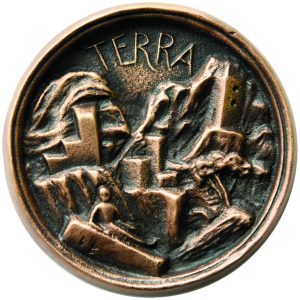
This year’s medals feature not only many of significant historical figures and events, but also independent artwork, in which the artist has complete freedom in choosing and depicting the theme and in expressing himself. Academic painter Daniel Brunovský (*1959, Bratislava), a representative of Slovak postmodernism, captivates with his unique and unmistakable style in his remarkable new cast medal Terra (Latin for “Earth”) from the Elements series, already known from previous years.
More about these medals and their stories, along with rich accompanying visual material, can be viewed in detail on the Medal of the Year 2025 website.
They were already on display on June 5 and 6, 2026, at the Bratislava Collectors’ Days and will also be featured at the Sběratel fair in Prague-Letňany on September 4 and 5, 2026, where the public announcement of this year’s results will also take place, and you can look forward to meeting the medal makers in person, chatting with them, and attending an autograph session. The award ceremony and announcement for invited guests will be held in the magnificent, historic building of the Museum of Decorative Arts in Prague, dating from end of 19th century. In addition to the partners of the Medal of the Year 2025 award, the Czech Association of Medal Artists, as well as the Czech Numismatic Society and the Slovak Numismatic Society at the Slovak Academy of Sciences, also contributed to the organisation and expert aspects of the event.


Medals are rolling to Prague!
(a play on the legendary 1990 Stones concert in Prague “Kameny se valí do Prahy“ – “The Stones are rolling to Prague”)
- 4–5 September 2026 – Sběratel fair (PVA Expo Prague):
– presentation and exhibition of medals participating in the most beautiful Czech and Slovak Medal of the Year 2025 poll,
– a meet-and-greet with the medal designers, including a signing session,
– public announcement of the poll results,
Friday 4 September 2026
– 1.00 pm–2.00 pm
Meet Master academic sculptor Michal Vitanovský in person, a renowned medallist and author of specialist numismatic publications, which you can also purchase here and have signed by him in person.


You can also bring along one of his medals or, for example, purchase from the Czech Mint’s stand this ‘The Assassination of the Slavníks dynasty’ 10 oz silver medal – which participated in this year’s Medal of the Year 2025 – and have it signed.

– 3:30 pm
Announcement of the winner of the prestigious ‘Medal of the Year’ poll, in which both Slovak and Czech works are participating for the first time. The general public voted for the most beautiful medal of 2025, choosing from a selection of 27 medals.
– 4.00–5.00 pm
Presentation of the publication/catalogue of medals ‘Karel Zeman Medals II’, combined with a book signing by the author
On Friday, after 4.00 pm, one of the most sought-after contemporary Czech medallists, Karel Zeman (also a stamp designer), will present the latest instalment of his catalogue and publication on his medals, entitled “Karel Zeman Medals II”, at the Medailérsky klub’s stand, where visitors will also have the opportunity to have this beautiful publication signed by the author.


‘Karel Zeman Medals II’ (2009–2025), 150 pages, 2025 – 118 medals, nos. 216–334.
‘Karel Zeman Medals I’ (2009) – medals nos. 1–215 (215 struck + 15 cast)
Award ceremony – announcement of the Medal of the Year 2025 results
– historic/main building of the Museum of Decorative Arts in Prague (17. listopadu Street No.2, 110 00 Prague 1)
– September 4, 2026
– under patronage of the Ambassador Extraordinary and Plenipotentiary of the Slovak Republic to the Czech Republic


The historic building of the Museum of Decorative Arts in Prague – the venue for the ceremonial announcement of the results of the Medal of the Year 2025, as well as for the World Congress and Exhibition of Modern Art Medals XXXIX FIDEM Prague 2027

EMBASSY OF THE SLOVAK REPUBLIC IN PRAGUE
H.E. Mr Martin Muránsky
Ambassador Extraordinary and Plenipotentiary
of the Slovak Republic to the Czech Republic
grants PATRONAGE
to
the award ceremony announcement of the results of the poll
“Medal of the Year 2025
for the most beautiful Czech and Slovak medal’
at the historic building of the Museum of Decorative Arts in Prague
on 4 September 2026
Prague, 27 July 2026
H.E. Prof. Dr. phil. Martin Muránsky, PhD.:
“The Czech Republic is our closest neighbour historically, a long-standing natural partner and a companion in civilisation through both the good and the bad days of history.”
“Slovakia has every reason to maintain and deepen its relations with the Czech Republic. There are no historical traumas between the two countries.”
MEDIA COVERAGE
June 5–6, 2026: Bratislava Collectors’ Days 2026, Incheba, Bratislava
Exhibition and presentation of the nominated medals


The two-day public presentation of the medals nominated for the 2025 Medal of the Year, combined with promotion of the ongoing voting, not only featured numerous interesting encounters and conversations with medal enthusiasts and collectors, but above all, it brought together a wide variety of other collecting communities, as well as the general public, and clearly demonstrated that medals can captivate literally anyone, regardless of age or personal preferences—not only through their admirable and appealing artistic and craftsmanship—that is, their aesthetics, appearance, or form—but also, and not least, through their content—that is, the depicted theme and the story behind the individual figures, events, or anniversaries to which the commemorative medals are dedicated—but also through the artists’ own artistic vision and imagination, particularly in the case of free-form creations, as they have managed to tackle the challenging task of condensing the entire essence into the limited space offered by a small medal, just as a good poet can explain the essence of a complex theme—or even the entire universe—in just a few verses.
One interesting and typical example was a meeting with a philatelist who immediately stated that he wasn’t interested in medals, yet ended up engaging in a long conversation about individual medals as he took an interest in the themes depicted on them and also acknowledged the high artistic value of many of these small works of art—the knowledge, and work that go into creatinpodal artist or by the craftsman who brings the artist’s vision to life in a durable medium, most often metal. While this philatelist will likely never become an avid medal collector himself, he will certainly remain an admirer of them. And in doing so, the medal itself fulfilled its purpose by commemorating the given theme in an attractive form.
The meetings with Mr. Jindřich Jirásek, Managing General Partner at Double Impact in Prague, Czech Republic, who organizes the largest collectors’ fair in Central and Eastern Europe—where we agreed to hold a public announcement of the results of the 2025 Medal of the Year award—as well as with Mr. Pavel Krejčíř, Head of Sales at AUKRO, the largest Czech and Slovak online marketplace combining B2C and C2C sales, particularly in the fields of collecting, art, and antiques, with whom we also look forward to a mutually beneficial collaboration.
TV News – Collectors’ Treasures, TV Markíza (June 5, 2026, 7:30 p.m.)


NOMINATIONS

The Last Words of president T. G. Masaryk (academic sculptor Jiří Harcuba)

John of Bohemia – 700 Years Since the Mintage of the Florin (MgA. Adam Alva Fejfar)

The Great Seal of Maximilian II of Habsburg (Drahomír Zobek (obverse) / Mgr. art. Roman Lugár (reverse))

Wedding Portrait of Maria Theresa (Drahomír Zobek)

150th Anniversary of the Birth of Designer Ferdinand Porsche (Michaela Appeltová, DiS.)

The World of Mushrooms (Barbora Zielinska, DiS.)

The Four Horsemen of the Apocalypse (Alžběta Blažejová, DiS.)

Archbishop Jozef Nuzík – Inauguration Medal (academic painter Karel Zeman)

Vratislav Eusebius of Pernštejn – Death Commemorative Medal (Jiří Rygl, Veronika Ryglová-Motěšická, Jaroslav Jelínek)

Jan Žižka, on the 65th anniversary of the founding of the Czech numismatic society branch in Tábor (Lenka Nebeská, DiS.)

80 years since the tragic events in Kremnička and Nemecká, 1945–2025 (Štefan Novotný)

160th anniversary of the death of D. Boehm – sculptor, medalist, and engraver (Štefan Novotný)

Juraj Langsfeld (Štefan Novotný)

100th anniversary of the minting of the first Czechoslovak 5-koruna coin (Mgr. art. Roman Lugár)

Greats of Slovak Painting – Miloš Alexander Bazovský (Mgr. art. Martin Sabol)

Nová Huta – Sinteu, the arrival of Slovaks in Romania (Asamat Baltaev, DiS.)

Bohumil Hrabal (Štefan Novotný)

Milan Rastislav Štefánik (academic painter Jozef Gertli Danglár)

John of Bohemia – commencement of coin minting (academic sculptor Zbyněk Fojtů)

The Assassination of the Slavníks dynasty (academic sculptor Michal Vitanovský)
The Battle of the Three Emperors (MgA. Martin Dašek)

Prof. Vítězslav Chlumský 1867–1943, Czechoslovak Orthopedic Society 1925–2025 (academic sculptor Milan Lukáč)

Doc. Dr. Milan Lehký – founder of Pharmacy Days (academic sculptor Marián Polonský)

Svätopluk (Ruler of Great Moravia) (Drahomír Zobek)

Zeus and Hercules, Greek Myths and Legends (Drahomír Zobek)

Nominations in detail
Folk Culture – Traditional Costumes – Final Medal of the Series
(Mgr. art. Roman Lugár)


Kremnica Mint, state-owned enterprise
struck, two-sided
60 mm
Ag 999/1000, 211,9 g, patinated, colored
150 pcs, numbered
The final medal in the “Folk Culture – Traditional Costumes” series represents the symbolic culmination of a unique collection dedicated to the rich tradition of Slovak folk clothing. The medal’s motif not only captures the beauty of embroidery, headdresses, aprons, and textiles, but also reflects the deep cultural roots and identity of the Slovak people. This medal is not only a collector’s item but also a dignified tribute to the richness of Slovak folklore, which deserves respect and preservation for future generations.
https://www.mint.sk/eshop/strieborna-medaila-ludova-kultura-kroje-zaverecna-medaila-serie

27 medals from the “Folk Culture – Traditional Costumes” series (designs, excluding the final medal)
Photo: Roman Lugár, Kremnica Mint studio
Séria bola robená v striebre, proof vyhotovení a v drevených kazetách (spočiatku po 6 ks, neskôr po 3 ks).
The series was produced in silver, in proof quality, and in wooden cases (initially in sets of 6, later in sets of 3).
Author Roman Lugár: “As for the ‘Folk Culture of Slovakia’ medal, I proposed creating a larger, final medal to conclude the series dedicated to Slovak folk costumes.
In this series, I tried to cover all regions of Slovakia and collaborated with the Slovak National Museum—the Museums in Martin (Ethnographic Museum)—and I owe them a great deal of thanks. Without their help, willingness, and professionalism, this would not have been possible. At the beginning, Dr. Alžbeta Gazdíková was a great help to me, and after she retired, her colleagues took over. They went out of their way to assist me, and at times I gave them quite a bit of work, because I was photographing embroidery, parts of folk costumes, headdresses, and the like—specifically from the villages to which the embroidery belonged (the originals). They also helped me with photographs (old photos by Pavol Socháň, a Slovak ethnographer, writer, journalist, painter, and prominent photographer and others) that they have in their archives. It was quite challenging to coordinate the photos, embroidery, and regions so that everything fits together.
The large final medal is simply the finishing touch, where I used materials I had already acquired—some of the ribbons are from Čičmany, and in the background is a drapery made from a part of the traditional costume from Veľký Lom.”

Design and plaster model of the final medal in the “Folk Culture—Traditional Costumes” series (Photo: Roman Lugár, Kremnica Mint studio)

Karol/Karel Plicka: Girl from Veľký Lom, 1928 (Source: Slovak National Gallery)

The colorful background of the large final medal is composed of a mosaic of ribbons from a wedding party, also from Veľký Lom. This photograph by Karel Plicka was used on the 2015 “Veľký Lom – Novohrad” medal.
As for the series, the medal author captured several different embroideries, tablecloths, aprons, blouses, ribbons, headdresses, and details of traditional costumes—several from each village.
The selection of characteristic embroideries and patterns typical of each region was entrusted to the aforementioned experts. The medal designs were then reviewed by Ms. Gazdíková.
As for the embroidery, the women created and refined the designs, drawing inspiration from one another and so on… which means that not all women in one village embroidered exactly the same way as those in another village, even though they maintained their regional style. Some regions were wealthier and used richer decorations, while others did not (due to the availability of thread); sometimes they reused an old, well-preserved piece and came up with a new one, making use of whatever they could. And besides, no woman wants to have the same dress as her neighbor, even if they look alike,” adds Roman Lugár.
The series showcases diversity, variety, and originality—cultural heritage
The last words of president T. G. Masaryk
(academic sculptor Jiří Harcuba)


Issued by: České dukáty (since 2026 part of Czech mint)
Struck by: Czech mint
struck, one-sided
19,75 mm: Au 986/1000 – 199 pcs, 3,49 g – ducat;
30 mm: Au 986/1000 – 37 pcs, 10,47 g – 3 ducat,
Ag 999/1000 – 1918 pcs, 10 g.
Numbered on the surface. Incuse strike.

The Last Words of president T. G. Masaryk, as dictated to his son Jan on his deathbed in September 1937, were sealed in a mysterious envelope for decades and were not opened until September 19, 2025.
The transcript, transcribed by Jan Masaryk, consists of three sheets (five pages), mostly in English, and focuses on personal and philosophical reflections rather than politics. The transcript bears witness to TGM’s philosophical outlook at the end of his life; it was assumed that this was not a political testament, but rather a message to his family or reflections on life.
The envelope was kept by Antonín Sum, Jan Masaryk’s secretary, who handed it over to the Czech National Archives.
The revelation of Masaryk’s secret was accompanied by a medal unlike any seen before (CNN Prima News)
On the anniversary of the founding of Czechoslovakia, October 28, 2025, a special limited edition of ducats featuring a portrait of T. G. Masaryk by leading Czech artist Jiří Harcuba was issued. Masaryk’s face bears Harcuba’s characteristic “glass-like” style, which gives it an incredibly evocative quality and sets it completely apart from conventional portraiture.
České dukáty prepared this exceptional issue to mark the unsealing of the envelope containing Masaryk’s last words in September of this year.
The ducat and other artifacts are stored in a luxurious white case featuring TGM’s initials in gold and the tricolor. The case’s color is a nod to Masaryk’s favorite riding attire, while the tricolor is a reference to Masaryk’s cap.
The medal itself is mounted in a passe-partout designed by artist Adam Alva Fejfar to resemble a First Republic postage stamp.
The package also includes TGM’s last words on handmade paper, a luxury magnifying glass, white numismatic gloves, a pin with the initials TGM—again designed by Adam Alva Fejfar—and a certificate of authenticity.
TGM’s Last Words – Gold Ducat
TGM’s Last Words – Gold Triple Ducat
TGM’s Last Words – Silver Commemorative Medal

Academic sculptor Jiří Harcuba (December 6, 1928, Harrachov – July 26, 2013, Prague) was a Czech glass artist, engraver, medalist, and professor at the Academy of Arts, Architecture and Design (VŠUP); a political prisoner during the Communist “normalization” period; after 1982, a professor at several American and British universities; rector of VŠUP from 1991 to 1994; and founder of engraving schools in Corning and Pilchuck, as well as the Dominik Biman International School.
At the beginning of Normalization (after Soviet invasion to Czechoslovakia in 1968), he was convicted for his design of a silver medal commemorating the 50th anniversary of the founding of Czechoslovakia—a design alluding to the Soviet occupation—which he created for his compatriots in Chicago in 1968. After the StB learned of the medal in 1970, he was immediately dismissed from VŠUP. During his arrest, he threw a work-in-progress plaque commemorating the death of Jan Palach into a skylight; his assistant later rescued it. He was interrogated, convicted, and imprisoned for five months from August 1972 to January 1973 in the prison for serious criminals in Plzeň-Bory. (Source: https://cs.wikipedia.org/wiki/Ji%C5%99%C3%AD_Harcuba)

50th Anniversary of the Founding of Czechoslovakia 1918–1968 / Occupation of the Czechoslovak Socialist Republic on August 21, 1968. Medal, Ag 19.89 g, 35 mm
In 1968, Jiří Harcuba created a medal for Czech expatriates in Chicago to mark the 50th anniversary of the founding of Czechoslovakia; however, the medal’s design alluded to the Soviet occupation of Czechoslovakia. When the StB learned of his medal, he was immediately dismissed from the Academy of Arts, Architecture and Design.
Harcuba had originally been finalizing the 50th-anniversary medal for minting at the Kremnica Mint, but he redesigned it after the events of August 1968. The obverse of the medal features a woman holding a linden branch—an allegory of Czechoslovakia—at which five bayonets are aimed, symbolizing the five Warsaw Pact states whose troops occupied Czechoslovakia. The reverse depicts the motto “Truth Prevails” alongside the presidential standard used since 1920 by Tomáš G. Masaryk and later by Edvard Beneš. The medal was likely struck abroad—presumably in Switzerland. Later, members of the Czechoslovak Philharmonic Orchestra reportedly managed to smuggle three of these medals—which had become a symbol of protest against the occupation by Warsaw Pact troops—into Czechoslovakia. (Source: Art+)
Jiří Harcuba studied at the Secondary Vocational School of Glassmaking in Harrachov, the State Vocational School of Glassmaking in Nový Bor, and later at the Academy of Arts, Architecture and Design in Prague (under the renowned Czech sculptor and architect Prof. Karel Štipl). After graduating from the Academy of Arts, Architecture and Design, he designed engraved and cut glass for the Art Center (later the Institute of Home and Fashion Culture) from 1954 to 1958 and collaborated on the creation of Prof. Karel Štipl’s engraved and cut glass column for EXPO ’58 in Brussels.
He subsequently returned to the Academy of Arts, Architecture and Design as a professor and earned his habilitation in 1970. A year later, however, he was forced to leave the academy for above mentioned political reasons. From 1971 to 1990, he worked as an independent artist in the fields of glass art and medal making. Starting in the late 1960s, he began focusing on medal making, particularly the design of coins, medals, orders, decorations, and plaques. To a lesser extent, he also created free-standing sculptures and architectural decorations. Beginning in the second half of the 1970s, he undertook a series of study visits abroad and later taught there as well. After 1989, he returned to the Academy of Arts, Architecture and Design and became its rector in 1991. He later founded the Dominik Biman International School, which specializes in glass engraving. In 1966 and 1993, the five-koruna circulation coin was produced based on his designs.

5 Kč (Czech koruna) coin (Source: Czech National Bank – more details)
“The medal bears Harcuba’s distinctive, highly economical style as a glassmaker. After all, what is art today? Is art tracing a photograph? Or is art capturing the likeness of a person—along with their inner dynamism—in just a few strokes? And Harcuba achieved exactly that. He brought this very skill from his glassmaking practice into medal making. In fact, this medal was created based on a glasswork. That’s why it may also be of interest to collectors who are primarily interested in glass,” says Dr. Michal Mašek, president of the Czech Numismatic Society, in his assessment of the TGM ducat issue by Jiří Harcuba.
The Jan Amos Comenius (Komenský) medal shares a similar history to this medal—that is, it was based on an existing glass model. It was first produced in 1977 in crystal glass, with a diameter of 170 mm, and then, 15 years later, in 1992, it served as the obverse for a minted double-sided “Memorial to National Literature” medal in tombac, 60 mm in diameter (not to be confused with another medal by J. Harcuba dedicated to J. A. Komenský, made of cast bronze in 1970, 130 mm, with the figure facing left)

Jan Amos Comenius (Komenský), 1977, glass, 170 mm (Photo: Moravian Gallery)


Jan Amos Comenius (Komenský) / Memorial to National Literature, 1992, tombac, 60 mm (Photo: Peter Kočvara)
České dukáty (Czech Ducats) Company:

“We want to show that a struck medal can be a modern and exclusive product that has its place in contemporary life. We are also responding to an oversaturated market flooded with mintings of average or even below-average quality.
Since its founding, České dukáty has prided itself on high artistic standards, and we want to set ourselves apart from the trend of unambitious production. “We want to emphasize our focus on exceptional artistic craftsmanship and originality. For us, the medal is not just a tradition, but an artistic category that has its place in today’s world,” says company founder Vladimír Olmr.
Czech Ducats: Part of the Czech Mint
The aptly named company České dukáty was founded in 2016 and set itself a significant goal: to restore the glory and authenticity of Czech ducat art.
Exactly ten years have passed since then, and the brand has entered the new decade with renewed energy. It has become part of the Czech Mint—a strong company with which it has been closely linked from the very beginning. “It is precisely at the Czech Mint, where, among other things, all Czech coins are minted, that most of the issues released by České dukáty have been produced to date,” explains Michal Voborník, director of the Czech Mint, adding that the merger will bring the brand long-term stability, technological infrastructure, and room for further development. Read more here.
John of Bohemia – 700 Years Since the Mintage of the Florin
(MgA. Adam Alva Fejfar)


Issued by: České dukáty (since 2026 part of Czech mint)
Struck by: Czech mint
struck, one-sided
28 mm, 37 mm, 60 mm
28 mm: Au 986/1000 – 30 pcs, 17,45 g – 5 ducats, ducat gloss;
Ag 999/1000, patina – 150 pcs, 13 g – 5 ducats;
37 mm: Au 986/1000 – 3 pcs, 52,35 g – 15 ducats, ducat gloss;
Ag 999/1000, patina – 150 pcs, 40 g – 15 ducats;
60 mm: Au 986/1000 – 3 pcs, 349 g – 100 ducats, ducat gloss;
Ag 999/1000, patina – 100 pcs, 155,50 g – 100 ducats.
Numbered on the edge.
Coins from days gone by were beautiful precisely because they were not perfect. They had a soul. And it is precisely this spirit that comes to life in the new medal by Adam Fejfar, created to mark the 700th anniversary of the minting of the first Czech gold coin—the florin. Instead of the sterile symmetry of modern technology, the artist chose a simple central composition and bold modeling, which lend the medal the raw authenticity of days gone by.
The obverse features a portrait of John of Luxembourg—the king who elevated the prestige of the Czech crown and earned a reputation as a knight throughout Europe. His face is not merely a symbol of sovereignty here, but an embodiment of the ideals of honor, courage, and statesmanship. The reverse is adorned with a stylized lily, a direct reference to the famous florin—the coin John had minted to place the Czech lands among the great powers of his time.
Symbolism and Significance
The lily is not merely a decorative motif—it represents a connection to the European monetary tradition and recalls John of Luxembourg’s ambition to bring the Czech state out of isolation. The medal as a whole is not merely a commemoration of a single event, but a tribute to currency as a bearer of trust, prestige, and national identity.


Adam Fejfar is a leading Czech sculptor and medalist who has long focused on depicting historical figures and symbols. As part of his collaboration with České dukáty, he has created exceptional portraits of presidents Tomáš Garrigue Masaryk (2024) and Václav Havel (2024), always emphasizing artistic originality and deeper cultural significance.


His work combines technical precision with emotional power—he presents not merely an image, but a story that touches on the nation’s identity and memory.

MgA. Adam Alva Fejfar (*1995)
Adam Alva Fejfar is a sculptor, medalist, and portraitist. He studied at the Academy of Fine Arts in Prague in the Studio of Figurative Sculpture and Medals under the guidance of Vojtěch Míča. He also completed an internship at the Iceland University of the Arts.
In his independent artwork, he explores the sense of space and hidden movement within the figure, and has long been dedicated to portraiture. He is the creator of public art installations and also works in relief, medal making, and numismatics.
The Great Seal of Maximilian II of Habsburg
(Drahomír Zobek (averz) / Mgr. art. Roman Lugár (reverz))


Numizmatika Kremnica s.r.o.
struck, two-sided, 60 mm
Ag 999/1000 (antique silver) – 2 oz (62 g)
200 pcs
A silver medal depicting the historic Great Seal of Maximilian II of Habsburg and a period portrait of him, made of 999/1000 silver, weighing 2 ounces (62 g), with an antique silver patina finish.
https://numizmat.sk/sk/strieborne-medaily-numizmatika-kremnica/velka-pecat-maximiliana-ii-strieborna-medaila


Portrait Side
Quote from Maximilian II on the medal’s inscription
“Pater patriae deus pro videbit” (Father of the Fatherland, God will see to it.)
The portrait is based on a depiction of Emperor Maximilian II Habsburg (1527–1576), attributed to the painter Guillaume Scrots, located at Ambras Castle in Innsbruck

Seal:
The depiction of the seal is based on a colored lithograph of the great seal of Maximilian II of Habsburg, Holy Roman Emperor and King of Hungary and Bohemia (from Illustration für Kulturgeschichte Des Deutschen Volkes by Otto Henne Am Rhyn (G Grote’sche Verlagsbuchhandlung, 1886).


From the work on the page featuring the seal. Photo: Roman Lugár
Wedding Portrait of empress Maria Theresa (Drahomír Zobek)


Numizmatika Kremnica s.r.o.
struck, two-sided, 60 mm
Ag 999/1000 (finish antique silver)
2 oz (62 g)
150 pcs
A silver medal depicting Empress Maria Theresa as a bride on her wedding day to Francis I, with a fineness of 999/1000 silver and a weight of 2 oz (62 g), inspired by the original sketch.
The reverse is identical to the obverse of the medal depicting Maria Theresa on the Great Seal and her coronation ceremony (-> Medal of the Year 2023)
150th Anniversary of the Birth of Designer Ferdinand Porsche
(Michaela Appeltová, DiS.)


Higher Vocational School in Jablonec nad Nisou
struck, two-sided, 50 mm, tombac
We are pleased to present the first graduation medal for the 2024–2025 school year from the collection of graduation projects at the Higher Vocational School (VOŠ) in Jablonec nad Nisou. It was designed by Michaela Appeltová, DiS. The medal was created to commemorate the 150th anniversary of the birth of automotive engineer Ferdinand Porsche. It is a double-sided, patinated medal that combines classically modeled relief motifs with engraved lines created on a CNC milling machine. This engraving was applied to the finished, surface-treated medal to properly highlight the contrast between the thin, luminous lines and the dark surface of the medal. Through this approach, the artist succeeded in evoking the aesthetics of technical design drawings on the medal. The work also includes a custom case in the form of a symbolic sketchbook. Porsche used to carry similar sketchbooks with him to quickly jot down his design visions. Michaela created this graduation project as her personal tribute to the engineering genius of this native of Vratislavice (german Maffersdorf).


From a young age, she would occasionally help her father and brother with repairs on their family cars at home. She likes cars, but what she enjoys most is the fact that this isn’t very common for a woman.
“Ferdinand Porsche is from Vratislavice (German: Maffersdorf im Isergebirge), which is not far from where I live. That, too, helped me decide fairly quickly on the topic for my graduation project. And also the fact that the VW Beetle is my favorite car,” says the medal’s designer.


Photo: Higher Vocational School in Jablonec nad Nisou
„Nicht die Technik macht Geschichte, sondern die Menschen, die sie erfunden haben.“ (It is not technology that shapes history, but the people who invented it) – Ferdinand Porsche (1875–1951)

The medal was on display:
– July 18, 2025 – January 11, 2026 – Sudetendeutsches Museum München (Sudeten German Museum, Munich): Ferdinand Porsche und andere Pioniere. Wegbereiter der Mobilität aus Böhmen und Mähren (Ferdinand Porsche and Other Pioneers. Pioneers of Mobility from Bohemia and Moravia)
– 22.02. – February 22 – September 20, 2026 – Isergebirgs Museum Neugablonz (Nový Jablonec/Kaufbeuren, Germany): FERDINAND PORSCHE UND ANDERE PIONIERE. Wegbereiter der Mobilität aus Böhmen und Mähren (FERDINAND PORSCHE AND OTHER PIONEERS. Pioneers of Mobility from Bohemia and Moravia)


Michaela Appeltová Dis.
(July 9, 2003, Jablonec nad Nisou/Czechia)
- Secondary School of Applied Arts and Higher Vocational School – Graphic and Plastic Engraving Design (2018–2022)
- Higher vocational education: Secondary School of Applied Arts and Higher Vocational School in Jablonec nad Nisou – Department of Struck Medals and Coins (2022-2025)
- University of West Bohemia in Pilsen, Ladislav Sutnar Faculty of Design and Art – Sculpture and Space Program (2025-)

Coin and Medal Designs for the Czech National Bank and the Czech Mint
2023
30th Anniversary of the Czech Currency and the Founding of the Czech Mint

2024
5,000 Kč (Czech koruna) – Moravská Třebová Historic Preservation District

2025
200 Kč (Czech koruna) – The Venus of Věstonice

2022
2nd place in a design competition for a seal and coin for the statutory city of Jablonec nad Nisou as part of its insignia (Jablonec nad Nisou City Hall)

2024-2025
2nd place in the competition for a commemorative medal marking the 90th anniversary of the Czech Mountain Rescue Service (Horská služba ČR)

Photo: Higher Vocational School in Jablonec nad Nisou, Michaela Appeltová
The World of Mushrooms
(Barbora Zielinska, DiS.)


Higher Vocational School in Jablonec nad Nisou
struck, two-sided, 50 mm, tombac
The “World of Mushrooms” medal is a graduation project by Barbora Zielinská, DiS., at the Higher Vocational School (VOŠ) in Jablonec nad Nisou. The work draws attention to the existence of the fragile, rich, and often overlooked kingdom of mushrooms and its vital importance to life on Earth.
The medal combines a classically modeled relief of more than two dozen species of mushrooms on one side with impressions of real natural objects on the other, which evoke the so-called mycelium—simply put, the underground network of mushrooms without which life as we know it could not have developed on Earth.

The artist creates a self-contained symbolic microcosm around the medals by placing them in Petri dishes lined with moss and pine needles. The glass form of the dish emphasizes the fragility of this microcosm while also allowing it to be observed. Any breakage of the dish would signify not only a physical but also a symbolic disruption of this microcosm.
The work thus serves primarily as a reminder of the invisible yet essential role of mushrooms in nature and their contribution to the existence of life itself.

Photo: Higher Vocational School in Jablonec nad Nisou
2025
Czech Republic Mountain Rescue Service (Horská služba ČR) – 90th Anniversary, single-sided, tombac, 200 pieces, struck by Higher Vocational School in Jablonec nad Nisou, 40 mm


Photo: Higher Vocational School in Jablonec nad Nisou
The Four Horsemen of the Apocalypse
(Alžběta Blažejová, DiS.)


Higher Vocational School in Jablonec nad Nisou
struck, two-sided, 50 mm, tombac
7 series each 4 medals
Plague, War, Famine, Death
The aim of Alžbeta Blažejová’s graduation project was to design characters based on the source novel and then transform them into a three-dimensional relief suitable for use on a medal.


She chose the theme from the symbolism of the Four Horsemen of the Apocalypse, as described in the last book of the New Testament—the Book of Revelation.
According to tradition, the Book of Revelation was written at the end of the first century A.D., and its authorship is attributed to the Apostle John. Through imagery and symbols, the book depicts a Christian vision of humanity’s dramatic future in its final era, in its last days. The four figures, described as horsemen, appear in the text when the first of the seven seals on the scroll received by the Lamb/Christ is broken. Each seal symbolizes a specific event that is to occur during the end of the world. In the book, the horsemen are directly linked to the impending events and symbolize the punishments, various forms of suffering, and tribulations that God may inflict upon humanity.


Alžběta Blažejová, DiS.
*24. 9. 2002, Liberec, Czechia
– 2018–2022 Secondary School of Applied Arts, Jablonec nad Nisou, Graphic Design program
– 2022–2025 Higher Vocational School, Jablonec nad Nisou, Coin and Medal Design program
– 2025–present Academy of Fine Arts, Prague, Figurative Sculpture and Medal Design studio

2023
Project for the Czech Mint – 30 Years of the Czech Mint and the Czech Currency


999 silver, patinated
100 mm, 1000 g, 200 pcs
Silver 1-kilogram medal commemorating 30 years of the Czech Mint and the Czech currency
37 mm, 1 oz/31.1 g, 1000 pcs
Silver 1-ounce medal commemorating 30 years of the Czech Mint and the Czech currency

2022 – Tattooing – Graduation Project “Handpoke m•project”. Permanent tattoo using the handpoke technique, in which ink is applied to the skin by hand without the use of a tattoo machine

2024
Commemorative Plaque – Karl R. Fischer, Founder of the Museum
State Museum of Glass and Costume Jewelry in Jablonec nad Nisou

Photo and text: Alžběta Blažejová, Higher Vocational School in Jablonec nad Nisou
Archbishop Jozef Nuzík – Inauguration Medal
(academic painter Karel Zeman)


Czech Numismatic Society branches in Kroměříž and Olomouc, Diocese of Olomouc
Struck by Petr Kazda – TRIGA K, Praha; case Studio Činčera, Praha
struck, two-sided, 60 mm
Tombac – 80 pcs
Silver Ag 999/1000, 110 g – 70 pcs
Medal commemorating the enthronement of the 15th Archbishop of Olomouc and Metropolitan of Moravia, Monsignor Josef Nuzík, held on April 13, 2024, at St. Wenceslas Cathedral in Olomouc
The Enthronement of Josef Nuzík as Archbishop of Olomouc
Josef Nuzík, the 15th Archbishop of Olomouc and Metropolitan of Moravia, wears the pallium—conferred by the Pope—around his neck on the Karel Zeman medal. The pallium symbolizes the lamb carried around the neck by the Good Shepherd.
During the enthronement ceremony at St. Wenceslas Cathedral in Olomouc, the Apostolic Nuncio presented the incoming archbishop with the crosier of the Archdiocese of Olomouc, which symbolizes, in a figurative sense, the shepherd’s staff. In addition to its decorative elements, this richly adorned crosier features a miniature figure of the Virgin Mary with the Infant Jesus at its center, located behind a portrait of Josef Nuzík.

The reverse side of the medal features the archbishop’s coat of arms against a background with a rosette from St. Wenceslas Cathedral. The trefoil in the center symbolizes the Holy Trinity and aligns with the patriarchal cross beneath the archbishop’s miter with tassels; the ten tassels on each side signify the rank of archbishop. In Archbishop Nuzík’s quartered coat of arms, the first and fourth quarters feature six points from the Olomouc archiepiscopal coat of arms, while the second and third quarters display Josef Nuzík’s personal canting coat of arms. We see a checkered triple hill, which refers to the Buchlov Hills as a dominant feature of Great Moravia and symbolically extends back to the first bishop, Methodius, as well as to the archbishop’s native region. A lily grows from the middle hill; this is an attribute of the archbishop’s patron saint, St. Joseph. On either side of the lily, ears of grain curve outward, carrying several symbolic meanings: they evoke the host, which is baked from grain, as well as the bread eaten at the Last Supper, which represents the Body of Christ in the Eucharist. The ears of grain are also an allusion to the Sower scattering his seeds as the faith of the Gospel, and thus they are connected to Josef Nuzík’s motto, “PROCLAIM THE GOOD NEWS” („HLÁSAT RADOSTNOU ZVĚST“), that is, the Gospel. Finally, the ears of grain refer to the archbishop’s origins in a farming family and his connection to the cultivated land. Below this emblem is the pallium. At the bottom of the medal, the archbishop’s motto completes the overall meaning.
Source: karel zeman medaile II., Hortus Moraviae, z. s. Kroměříž, 2025


Vratislav Eusebius of Pernštejn – Death Commemorative Medal
(Jiří Rygl, Veronika Ryglová-Motěšická, Jaroslav Jelínek)


Designed by Jiří Rygl, Veronika Ryglová-Motěšická
Czech Numismatic Society branch in Brno
Manually engraved and struck by Jaroslav Jelínek
struck, two-sided, 42 mm, Ag 999
30 pcs, numbered, 28 g ± 5 %
Death thaler medal of Vratislav III Eusebius of Pernštejn / Extinction of the House of Pernštejn—the last male member of this family died in 1631 during the Thirty Years’ War.


The earliest ancestors of the House of Pernštejn can be traced back to the 13th century. At that time, they bore the predicate “of Medlov,” named after a village in South Moravia. They colonized the area around the upper reaches of the Svratka River and, in the second half of the 13th century, built a castle there bearing the name Pernštejn. The first documented use of the predicate, derived from this castle, dates to 1285 and is associated with Štěpán II of Medlov and Pernštejn.
The family’s first great period of prosperity came during the Moravian Margrave Wars, in which Jošt and Prokop of Luxembourg vied for dominance in the country, and Vilém I of Pernštejn skillfully maneuvered between the two sides.
Another period of expansion was the time of the Hussite Wars, during which the Pernštejns sided with the Utraquists. In the subsequent reign of King George of Kunštát and Poděbrady, and later during the Jagiellonian period, William II of Pernštejn distinguished himself by greatly expanding the family’s holdings to include estates in Eastern Bohemia.
Jan IV of Pernštejn, known as “the Rich,” the son of Vilém II, was a leader of the estates’ opposition and a supporter of Protestantism. As a leading magnate, he lent Emperor Ferdinand I a substantial sum, in exchange for which he held the County of Kladsko as a pledge, including the right to mint coins. He minted ducats, 3 thaler coins, 2 thaler coins, tolars, 1/2 thaler coins, 1/4 thaler coins, groschen, and halers there.
The last male member of the family, Vratislav III Eusebius, was born in 1594. By that time, the vast Pernštejn estate was already in disarray, but it cannot be said that the family was struggling to survice. The Litomyšl estate, saved from sale by a lien, became Vratislav’s personal property; he also purchased a palace in Malá Strana (now used by the Parliament of the Czech Republic). In the post-White Mountain period aka “Dark Age”, Vratislav sided with the victors and fought in the Thirty Years’ War with the rank of cavalry colonel. However, on July 26, 1631, he was seriously wounded and died in an insignificant skirmish with Swedish troops near the town of Tangermünde (today Saxony-Anhalt, Germany).
Vratislav III Eusebius of Pernštejn died without issue, and his estate passed to his sister Frebonia, who, upon her death in 1646, was the last bearer of that name. The Pernštejn legacy, however, was taken up—at least symbolically—by the Lobkowicz family. Through Polyxena, Vratislav’s aunt, the Lobkowicz family incorporated the Pernštejn European bison’s head into one of the fields of their coat of arms.

Medal No. 29 was bestowed upon Prince William E. Lobkowicz (b. 1961, Boston, Massachusetts, U.S.A.), who belongs to the second-born branch of the family, but this branch manages the family’s extensive The Lobkowitz Collections. This collection also houses the only known likeness of Vratislav Eusebius of Pernštejn, namely a portrait medallion. The creators of the medal based their design on this image.

The graphic design for the medal was created by Veronika Ryglová-Motěšická, based on materials provided by her husband, Jiří Rygl Jr., the initiator and organizer of the medal and executive director of the Brno branch of the Czech Numismatic Society, who also researched and provided all the details depicted on the medal.

The production of the medal was then handled by Mr. Jaroslav Jelínek, who engraved and tempered the dies, cast and rolled the silver, made the blanks, struck the medal by hand with a hammer in several passes, and applied the patina.
He is a conservator at the Technical Museum in Brno; he turned 70 in 2025. He is a long-time member of the committee of the Brno branch of the Czech Numismatic Society and currently serves as the registrar. Otherwise, he designs his own mintings; only the series on extinct Moravian families features are designs by Jiří and Veronika Rygl.
Jaroslav Jelínek primarily designs and strikes tokens; he has already produced more than 600 different types for various events, exhibitions, and interesting exhibits at the Technical Museum in Brno. He also engages in experimental striking using unusual materials. He also creates historically accurate reconstructions of die production, blank preparation, and the minting of four-strike coins, the Prague groschen, and similar items. As for his collecting interests, they center primarily on the ancient world, with a particular focus on Rome.
The thaler is marked with the initials JJ (Jaroslav Jelínek) and JVR (Jiří and Veronika Rygl).
“The idea came to me based on the auction token for our branch’s 186th auction. It was a medal by Burian Trčka of Lípa, who did not have the right to mint coins but had a medal made in 1588 that had the weight and shape of a thaler. Striking a coin of this size by hand is not so easy, and Mr. Jelínek was, moreover, overwhelmed with striking various variants of this design. He didn’t even want to hear about thalers at that time. However, I managed to persuade him—and perhaps even inspire him—with the idea of striking memorial thaler medals for prominent Moravian families. More specifically, those that were dying out around the year 1600—prominent families who influenced the history of Moravia and became an inseparable, integral part of it. Right from the start, we set one goal for ourselves. Twenty pieces, and no variations in material or shape. In the end, we agreed on thirty pieces, and I can say with a certain pride that, when it comes to the variations, all of our purchasers are treated equally.“It’s tempting to have, say, two clips or a copper strike made, but there really are only thirty numbered pieces in silver,” says Jiří Rygl Jr., adding:
“But what is the physical difficulty of this strike, which is made by hand with a hammer in four to six blows (with the appropriate annealing step in between)… Moreover, Mr. Jelínek smelts and rolls the silver himself.The first piece minted was Jan Šembera of Černohorský from Boskovice, the last member of the Boskovice family. The next is Vratislav Eusebius of Pernštejn. Tas of Meziříčský from Lomnice should follow, and then Kateřina of Kunštát. But it’s better to hope than to count on it. After all, given his age, this is an incredible feat for Mr. Jelínek.”


A test cast in modeling clay and a deliberately damaged die for the reverse side
Jiří Rygl Jr. goes on to explain how the medal-making process works: “I choose a historical figure. I study their biography and try to go back to the original sources, looking for variations of their name in Latin (which is the language we use on these medals). Sometimes this is difficult; other times, I have several options. Then I try to find period depictions. I research the clothing and look for details on period accessories, jewelry, armor, swords, etc. After that, my wife, Veronika Rygl Motěšická, creates a few sketches, and we discuss what to depict from which angle and what clothing to use, etc.My wife then gradually finalizes the design, and we present it to Mr. Jelínek, with whom I consult again on the technical side—what can or cannot be done, where to make changes, and so on.Once the design is completed in pencil, it is traced with a pencil. Any shading or details that Mr. Jelínek doesn’t want are removed.Mr. Jelínek then transfers the design to the die using a grid. He calculates the spacing of the letters and the gaps between them so that everything lines up correctly during stamping.Then the lengthy and demanding process of handcrafting the die begins. This is followed by hardening and then the actual stamping.”

Jiří Rygl Jr. depicted as the head of a monarch on a coin
Veronika Ryglová-Motěšická, the wife of Jiří Rygl Jr., is not a professional artist, but she used to devote herself, among other things, to designing coins. They are created using a dot-and-line technique with ink. Today, they are on display in the clubhouse of the Brno Numismatic Society.


The first coin in the series features Jan Šembera Černohorský of Boskovice. Medal No. 29 was bestowed as a mark of favor upon Prince Hans-Adam (Czech Jan Adam) II of Liechtenstein, the ruling prince (Jan of Boskovice had two daughters, both of whom married members of this family).
Text: Jiří Rygl ml., Jan Vlček (member of the Czech Numismatic Society in Brno)
Photo: Jiří Rygl Jr. (executive director of the Czech Numismatic Society in Brno), wikipedia, historickaslechta.cz
Jan Žižka, on the 65th anniversary of the founding of the Czech numismatic society branch in Tábor
(Lenka Nebeská, DiS.)


Czech Numismatic Society branch in Tábor
Struck by: Petr Kazda – TRIGA K, Prague
struck, two-sided, 50 mm
Silver Ag 999/1000, 2 oz/~ 62,2 g – 55 pcs
Copper Cu, ~ 56 g – 55 pcs
On the 65th anniversary of the founding of the Czech numismatic society branch in Tábor
In 2025, the Czech numismatic society branch in Tábor commemorated the 65th anniversary of its founding. To mark the occasion, it issued a commemorative medal featuring Jan Žižka, designed by medalist Lenka Nebeská, DiS, according to the branch’s specifications.
The obverse of the medal features a nearly three-meter-tall statue of the Hussite military leader Jan Žižka of Trocnov, who played a key role in the founding of the town of Tábor. The sandstone statue, carved from a single block by the Ducháček brothers’ workshop under the direction of Josef Ducháček based on a model by sculptor Josef Strachovský, was unveiled 140 years ago, on October 26, 1884, in Žižka’s central square in Tábor. Its cost at the time was 2,250 Gulden/Florin.
However, this event was preceded on August 26, 1877, by the unveiling on the same pedestal of a metal statue by Josef Václav Myslbek; unfortunately, it was poorly cast in zinc by the Grünn foundry, and due to its tilt, the statue had to be removed in June 1878.
The obverse of the medal features the sites of Žižka’s victorious battles and elements from the banner of the Táborite faction of the Hussite movement.

Monument to Jan Žižka of Trocnov (photo Tourist Information Centre Tábor)
The reverse side of the medal features a historic architectural landmark of the city of Tábor—the Bechyně Gate with the tower of Kotnov Castle—set within a relief of the late-Gothic gable of the Škoch House on Žižka Square, adjacent to City Hall. The house was rebuilt following the great fire of Tábor in 1532. The gable features a flame motif with arches shaped like a donkey’s back. The overall composition of the reverse thus evokes both the “grids of isolation” into which the Taborites were confined after their defeat at the Battle of Lipany in 1434, and the “temple of truth” of God’s law, which was built here by the disciples of the burned preacher of truth and reformer of the church—Master Jan Hus.
Lenka Nebeská, DiS.

17.8.1984
2000–2003 – Vocational School of Arts and Crafts, Podkovářská – Prague
Field of study: Artistic Ceramics (internship at BaF on Kampa, instructor Z. Bedrna)
2003–2005 – Vocational School of Arts and Crafts, Podkovářská – Prague
Field of study: Arts and Crafts
2004–2005 – Sculpture courses with academic sculptor J. Sejka
2005–2007 – Higher Vocational School of Applied Arts, Jablonec nad Nisou
Field of study: Struck Medals and Coins
2005–2007 – Faculty of Education, Charles University, Prague
Field of study: Teacher Training Program for Elementary and Secondary Art Schools
Member of the (Czech) Association of Medal Artists (AUM) since 2007
One of the representatives of the Czech Republic at traditional exhibitions of world medal art held as part of FIDEM (International Art Medal Federation) congresses. She has regularly exhibited in Tampere, Glasgow, Sofia, Ghent, Ottawa, Tokyo, and Munich since 2010.
If it can be said of most medal artists and AUM members that they are versatile in their work, this is especially true of Lenka Nebeská. Even as a child, she devoted herself to creating works from a wide variety of materials, through which she developed her imagination and strengthened her connection to the visual arts, a passion further nurtured by reading literature on art. After graduating from the Secondary School of Applied Arts, chance led her to study medal and coin design at the Higher Vocational School in Jablonec nad Nisou, and it’s no exaggeration to say that she fell in love with this work. Some time ago, it became clear to her that she wanted to devote herself to medal making permanently. However, given the nature of this profession, she must—though not reluctantly—expand the scope of her artistic activities considerably. And so she also devotes herself to ceramics, which she teaches; she trains ceramics instructors for children; she collaborates with tile stove restorers; she creates her own tile replicas and restores ceramic and plaster sculptures; and she paints and draws. And since she also cares for her three-year-old son, she has more than enough to keep her busy.
She works for the Czech Mint in Jablonec and has successfully participated in competitions for commemorative coins issued by the Czech National Bank. She also accepts other commissions for minted medals. She is now a staff medalist at the Czech mint in Jablonec, for which she has created designs for entire series dedicated to, for example, UNESCO World Heritage Sites (Prague, Kutná Hora, etc.). These coins are made of platinum, and when preparing the designs, Lenka experimented with very shallow relief—shallower than on other mintings—because that is what minting in platinum requires. The medalist also creates medals commemorating Czech historical events and figures. For commissioned pieces, she draws on her rich imagination, channeling it through the given theme and classical formal language.
Of course, this is different with her independent artworks, where she often creates surprising, innovative pieces. We cannot overlook her medal or plaque hidden inside a book-shaped case, which alludes to her favorite readings (J.P. Sartre: The Wall, E. A. Poe: The Raven). Her other independent artworks also demonstrate the artist’s thoughtful reflection on the world, social events, the laws of human life, inner workings of the mind, and phenomena and events that should not be forgotten…The plaque Adolescence shows how a child’s little wings grow into wings of freedom, ideals, and imagination; Cradle, featuring computer components, expresses a new era inextricably linked to the computer networks that surround our civilization and on which it depends; Brain Teasers consists of heads with variously shifted parts, which likely signify that people are constantly grappling with life situations that are, for them, such brain teasers.
Authors of the text: Juliana Boublíková Jahnová, Věra Němečková, Kateřina Nora Nováková
More about Lenka Nebeská – Czech mint, Prague mint
80 years since the tragic events in Kremnička and Nemecká, 1945–2025
(Štefan Novotný)


Slovak Numismatic Society at the Slovak Academy of Sciences – branch Banská Bystrica
Struck by: Castax Slovakia, s.r.o., Trenčín
struck, two-sided, 60 mm
Silver Ag, ~125 g – 40 pcs
Copper Cu: 80 pcs
Remember! 80 years since the tragic events in Kremnička and Nemecká! Nemecká… Painfully glorious is our journey toward freedom / Kremnička… Remember, O living, the sacrifices of the struggle 1945–2025
The medal was issued to commemorate the 80th anniversary of the tragic events when Gestapo units, supported by rapid-response units of the Hlinka Guard, murdered several hundred partisans, civilians, and residents of Jewish descent (The Hlinka Guard was the primary paramilitary militia and repressive arm of the Hlinka Slovak People’s Party (HSĽS), the sole ruling party of the fascist Slovak State (1939–1945). It functioned as a willing collaborator with Nazi Germany, enforcing anti-Semitic policies and terrorizing political opponents.). The massacres took place at the lime kiln in the village of Nemecká and in the anti-tank trenches on the outskirts of the village (now a district of Banská Bystrica) of Kremnička. The exact number of victims remains unknown to this day. On the occasion of a memorial ceremony, the village of Kremnička presented some of the medals to public figures—the President of the Slovak Republic, the ambassadors of the Hellenic Republic and the United Kingdom, and members of the Jewish religious community in Slovakia.
The obverse depicts the memorial and commemorative site of the Slovak National Uprising in Nemecká, which stands on the grounds of a local lime factory, known as a “vápenka” (lime kiln). Between January 4 and 11, 1945, the German Nazi unit Einsatzkommando 14, in collaboration with the Slovak Emergency Units of the Hlinka Guard, carried out mass executions of hundreds of victims here. The site is located in the Ráztocka Valley, and the executions were carried out in secret so that the citizens of Nemecká would not notice them. It was one of the greatest war crimes committed on Slovak territory, with an estimated number of over 500 people executed, along with the related massacre in Kremnička near Banská Bystrica, where 747 victims were executed over the course of five months.
After the war, the lime kiln (or rather, the part of it that had not been destroyed) was restored and turned into a memorial site to commemorate the tragic events that took place on its grounds.

Cultural Monument: Nemecká Memorial (Photo: Muzeum.sk)
In 1958, a memorial was erected next to the lime kiln. It consists of two parts: a sculpture resembling the flame of a furnace, created by the academic sculptor Alexander Vika (Dr.h.c., Assoc. Prof., Acad. Sculptor Alexander Vika, a leading figure in Slovak sculpture and medal art, * May 10, 1933, Bratislava – † April 21, 2025, Bratislava, a student of Prof. Rudolf Pribiš, the doyen of Slovak relief sculpture and medal art), and is made of white cement and crushed marble, standing 12.50 m tall, with a statue of a kneeling woman with outstretched arms in front of it—created by academic sculptor Klára Patakiová (* May 14, 1930, Šahy, a student of Prof. Jozef Kostka and Prof. Fraňo Štefunko) made of bronze and approximately 3.00 m tall, which was added to the memorial later in 1961.
On the wall of the memorial wall next to the lime kiln is the inscription “Nemecká Memorial.” According to those familiar with the memorial, however, there was also once a verse from Kostra’s poem inscribed there, a portion of which appears on the obverse of the medal:
“Remember, O living, the sacrifices of the struggle; reflect on the suffering of the fallen; think of how they went into the fire and the surf, for your dreams and your thoughts.” – Ján Kostra
The inscription on the reverse of the medal—“Painfully glorious is our journey toward freedom!”—are verses by the poet Andrej Plávka, which form the centerpiece of the memorial in Kremnička:
Here we silently guard the glorious year of 1944
breathing the legacy of this blood-soaked soil
let history examine the exclamation mark of our death
painfully glorious is our journey toward freedom!

The Most Solemn Place in Slovakia, Featuring a Stone Memorial by Architect Dušan Jurkovič
On the outskirts of Kremnička, German Nazis, together with Slovak Hlinka guards, murdered hundreds of people and threw their bodies into a ditch.
We would probably search in vain for a more solemn place in Slovakia. On the outskirts of Kremnička, the presence of death is palpable. Side by side here stand the Banská Bystrica crematorium, the urn grove, the funeral home, the cemetery, and the local SNP Memorial. At the end of the war, the entire area was drenched in the blood of hundreds of executed people, whose bodies the German Nazis and Slovak Hlinka guards threw into a large anti-tank trench and buried. After the turn of the millennium, however, these horrific events were more reminiscent of history textbooks. The stone memorial by Slovak architect Dušan Jurkovič, originally built on a bare plain as a memento visible from afar, had until recently been neglected, forgotten, and hidden in the shade of tall, old thuja trees.


As if that weren’t enough, family homes have sprung up right on the edge of the ditch that the fascists turned into a mass grave. “A thousand people murdered—shot in the back of the head or suffocated under the bodies in the pit. Including children. The youngest was only two weeks old,” says writer and historian Daniela Baranová, who published the book At the Gates of Hell in 1995, in which she describes the killings in Kremnička and the memories of survivors when rumors first began to circulate about possible construction near the memorial. She hoped people would come to their senses. They didn’t. First one street sprang up, then another. “Where the newest houses now stand, hundreds of exhumed victims were buried in 1945; roughly three hundred of them are still underground,” she continues, picking up the slim volume, which has also been translated into Hebrew. “When the SS executed about three hundred people in a single day in December 1944, the blood flowed all the way to the Hron River. Those who tried to escape were shot like rabbits. People were dying all around. That place is full of suffering, negative energy, and drenched in blood.”
“Hitler himself was shocked that a small nation, surrounded by hostile or occupied states, dared to revolt and resisted overwhelming odds for months,” concludes Daniela Baranová.
“We attach little importance to our history, and we still have an ambiguous attitude toward the Uprising,” says Marcel Pecník, director of the Central Slovak Museum. “The memorial is a nationwide memento—I would even say one of European significance. Jurkovič designed it to be visible from a wide area.”

After the uprising was suppressed, the Banská Bystrica prison filled up not only with resistance fighters but also with people suspected of aiding the partisans, and it could not cope with the influx. “The death penalty was not officially enforced at that time, and people whose documents stated that they had been released were sent to Kremnička. They were shot without trial— including women, children, the elderly, Jews, Roma, and foreigners suspected of participating in the Slovak National Uprising.”
Sources:
A Forgotten Memento: New Settlers Had No Idea They Would Be Living Right Next to a Nazi Mass Grave, Peter Galan, Plus 7 dní, February 11, 2024
Cultural Monument: Nemecká Memorial, Muzeum.SK
Memorial and Commemorative Site of the Slovak National Uprising in Nemecká, Wikipedia
Will the SNP Memorials Disappear Along with the SNP Memorials? Pravda.sk
Memorial to the Victims of Fascism in Kremnička, Relaxos
160th anniversary of the death of J. D. Boehm – sculptor, medalist, and engraver
(Štefan Novotný)


Slovak Numismatic Society at the Slovak Academy of Sciences – Svit-Tatry
Struck by: Castax Slovakia, s.r.o., Trenčín
struck, two-sided, 60 mm
Silver 999/1000 – 40 pcs
Copper Cu – 45 pcs
Jozef Daniel Boehm (also known as Joseph Daniel Böhm; 1794–1865) was a prominent Austrian sculptor, medalist, and engraver originally from Spiš (Spišské Vlachy). He is considered one of the key figures in 19th-century Central European medal art.
Based on a concept by PhDr. Marián Soják, PhD, chairman of the Slovak Numismatic Society at the Slovak Academy of Sciences (SAV), Svit-Tatry branch, and also chairman of the Central Committee of the SNS at the SAV, the medal was crafted by Kremnica-based medalist Štefan Novotný.
The obverse features a portrait of J. D. Boehm, which Štefan Novotný created some time ago (in the 1980s) based on source material he obtained from Vienna. At that time, he created a plaster model of Boehm’s portrait, originally intended to be issued as a medalby the Svit-Tatry branch—then led by Ferdinand Lauko However, the minting never took place. Štefan Novotný donated one model to the town leadership of Spišské Vlachy (the plaster model is now lost), while the artist kept one for himself. “We incorporated that model into the obverse side of the medal, where we added the silhouette of the town of Spišské Vlachy (with its main landmarks—the church and town hall), where Boehm was from. After his departure for Vienna (hence the depiction of a carriage and the inscription VIENNA), this prominent sculptor and medalist eventually became the director of the Vienna School of Engraving,” states Marián Soják, a professional archaeologist at the Archaeological Institute of the Slovak Academy of Sciences, Spišská Nová Ves branch, specializing in prehistory (particularly the Neolithic and Eneolithic periods) of mountainous and foothill regions (especially Spiš), intercultural relations with the territory of present-day Poland, and speleoarchaeology in Slovakia (with a focus on eastern Slovakia).
The obverse of the medal bears the inscription: VIENNA SCULPTOR, MEDALIST, A NATIVE OF SPIŠKÉ VLAHY. Signed NOVOTNÝ along the lower edge.
The reverse features the obverse design of an interesting Boehm medal of high artistic value, which is connected to Slovakia. It was issued on the occasion of a congress of physicians and natural scientists, which took place from August 10–15, 1846, alternately in Košice and Prešov. It depicts two female figures adorned with city crowns; the one on the right holds a shield bearing the coat of arms of Košice, while the one on the left holds a shield bearing the coat of arms of Prešov. A TESTVÉRILEG EGYESÜLT SZ. K. VÁROSOK KASSA ÉS EPERJES (Sister Cities Košice and Prešov); the exergue bears the year MDCCCXXXXVI (1846), and beneath the cornice on the left is the signature I. D. BOEHM F.
Below the described medal is the emblem of the Slovak Numismatic Society at the Slovak Academy of Sciences (SAV), SVIT-TATRY branch—a motif of a Celtic silver drachma of the Athena Alkidemos type, discovered in 1977 at the archaeological site of Veľký Slavkov–Burich. A similar type of Celtic coin was found in the Spiš region at Jánovce-Machalovce, at the Pod Hradiskom site. The reverse side of the medal bears the following inscription: SLOVAK NUMISMATIC SOCIETY AT THE SLOVAK ACADEMY OF SCIENCES, SVIT-TATRY BRANCH-2025.

Veľký Slavkov, Burich. A drachma of Athena Alkidemos depicting a warrior, discovered in 1977 (photo: M. Soják).
A Celtic drachma of the Minerva/Athena Alkimedos type from Veľký Slavkov
An exceptionally well-preserved Athena-Alkimedos-type drachma from the fortified hill of Burich near Veľký Slavkov dates to the first half of the 2nd century BCE; discovered in 1977 in Veľký Slavkov, it is today considered an exceptional specimen among Celtic coinage.
Athena Alkimedos, Type B—featuring a warrior figure, ca. mid-3rd to early 2nd century BCE.
Obverse: The head of the Roman goddess Minerva wearing a helmet, facing right; beneath the chin and along the long neck are remnants of two meandering patterns. Around the edges are hints of a pearl border made of small dots.
Reverse: A stylized figure of a standing warrior—Athena Alkidemos—walking to the left with a shield and a javelin. Below her hands are two pairs of descending lines in the shape of an inverted V (converging stoles?), above the shield is a cross topped with small spheres; below the lower edge of the shield is a hint of a vertical, broken zigzag in the shape of MM and the symbol Π; to the right of the figure, the symbol E is clearly visible; near the right edge is a faintly legible vertical inscription CIEC-IV or a variant thereof. Around the edges is a worn pearl border.
Results of the XRF (X-ray fluorescence) analysis of the specimen from Veľký Slavkov from 1977: Ag – 96.775%, Cu – 1.698%, Au – 1.026%, Pb – 0.260%, Fe – 0.180%, Ir – 0.061%.
To date, 13 specimens are known; those that have been located come from Nižbor-Stradonice in the Czech Republic, from Veľký Slavkov (2 km north of Poprad), from southern Moravia, and from the vicinity of the town of Zvolen. The other eight known specimens lack any information regarding their discovery circumstances. A new find of this type of Celtic coin from Jánovce-Machalovce (10 km east of Poprad) is thus the third specimen with clear discovery circumstances, i.e., with a precisely determined location. However, this specimen is damaged by corrosion and long-term agricultural activity at the site; some details are barely visible. It appears that all the coin strikes recorded to date originate from the same die.
Currently, three types of silver coins are known which, based on iconographic, weight, and find-related evidence, belong—along with the gold coins of the Athena Alkidemos type—to a single group of Celtic coinage. Since the distribution of finds to date and the characteristics of the silver coins of all three types mentioned, as well as the gold coins depicting a standing warrior, point to the work of mints associated with the Central European Celts, and in accordance with the historically established designation, the term “Athena Alkidemos group” is used for all these coins. This name is derived from Hellenic models depicting the goddess Athena Alkidemos, who, as the protector of the people, cities, and states, was portrayed in a flowing robe, wearing a helmet, holding a shield in her left hand and a spear in her right. Today, the corridor of the Central European section of the Amber Road is considered the most likely place where they were minted. Foreign coins, including the aforementioned drachma depicting a warrior, indicate the important status of this Púchov culture site, located in an area rich in the necessary iron ore—a vital commodity that was the subject of a well-developed and, as the coins show, widely ramified trade.
Sources: Marián Soják, further:
Marián Soják: A Celtic drachma from the Athena Alkidemos group found in Jánovce-Machalovce, Denarius – Numismatic Journal, No. 8, 2020, Slovak National Museum – Historical Museum, pp. 14-19
Marián Soják: Coin Finds and the Penetration of Ancient Influences into the Spiš Region
Hlinka, J. 1980: A Unique Find of a Celtic Silver Coin in Veľký Slavkov. Slovak Numismatics 6, pp. 257-259;
Marián Soják, Institute of Archaeology, Slovak Academy of Sciences: Finds of Celtic Coins from Northern Slovakia, Biatec, Numismatics, Vol. 20, No. 1/2012, pp. 28-30
Juraj Langsfeld (Štefan Novotný)


Slovak Numismatic Society at the Slovak Academy of Sciences – branch Martin
Castax Slovakia, s.r.o., Trenčín
Designed by Igor Svinčák
struck, two-sided, 60 mm
Silver Ag – 50 pcs (numbered)
Copper Cu – 85 pcs (unnumbered)
The central motif on the obverse of the medal is possibly a portrait of Ďurko Langsfeld with a saber, depicting him as a Slovak nationalist and volunteer lieutenant (his portrait has not survived). Above Langsfeld’s portrait is the period emblem of the Slovak National Council, along with the year the medal was issued. Behind Langsfeld is a group of volunteers from the Štúr era. The place and year of birth and death are inscribed on the right and left edges of the medal. The reverse of the medal is dominated by what is likely a scene depicting Ďurko Langsfeld being led away on horseback by Honvéd soldiers to the place of execution. In the background is the town castle with St. Catherine’s Church and parts of the town of Kremnica. Around the edge of the medal is the text: “Now my enemies are judging me, but the Slovaks will also judge me, and I would not want to fail in their eyes.” Langsfeld uttered these words on June 22, 1849, before a military court in Kremnica. Langsfeld was offered a pardon if he renounced the Slovak national cause and defected to the Hungarian insurgents. He resolutely refused, stating precisely that he did not want to “fall from grace” with the Slovaks.
The text around the edge of the medal reads: Slovak Numismatic Society at the Slovak Academy of Sciences – branch Martin, 2025.
Text: Mgr. Miroslav Kurpel
Juraj Langsfeld, or Ďurko Langsfeld (born Oct. 16, 1825, Sučany – † June 22, 1849, Kremnica) was a Slovak nationalist, a teacher in what was then Turčiansky Svätý Martin, and, from January 1849, a volunteer officer (lieutenant) in Hurban’s army during the Slovak Uprising of 1948; He was executed by hanging in Kremnica by the Hungarian army for his loyalty to the Slovak nation.
On October 28, 1849, Langsfeld was symbolically and ceremoniously buried in Kremnica by Slovak volunteers, with Langsfeld’s teacher Ondrej Hodža also in attendance. Jozef Gregor Tajovský wrote a biographical work about Langsfeld titled “The Death of Ďurko Langsfeld” and also initiated the construction of a monument at the site of his grave, which was ceremonially unveiled on October 28, 1922. The monument was built by Matica Slovenská in Kremnica with the help of workers from the Kremnica Mint and the town’s residents. Matica Slovenská also organizes commemorative events on the anniversaries of Langsfeld’s death.
The inscription reads as follows: HERE LIES THE SLOVAK VOLUNTEER JUR LANGSFELD, A NATIVE OF SUČIANY, WHO WAS EXECUTED HERE ON JUNE 22, 1849, AS A FIGHTER FOR THE RIGHTS OF THE NATION.
The tombstone is the work of sculptor and medalist Jan Čejka (medalist and engraver at the mint, Jan Čejka (*January 30, 1878, Vienna – †1925, graduate of the Vienna Academy of Engraving)). Town of Kremnica, Žiar nad Hronom District. Slovakia.


Juraj Langsfeld, grave with monument. It is located near the boundary between the Kremnica city limits and the village of Kremnické Bane, across a small stream, next to State Road I/65. Bus stop: Kremnica, Tri domy. City of Kremnica, Jurka Langsfelda Street, Žiar nad Hronom District. Slovakia.
Photo: Ing. Mgr. Jozef Kotulič
100th anniversary of the minting of the first Czechoslovak 5-koruna coin
(Mgr. art. Roman Lugár)


Kremnica Mint, state-owned enterprise
struck, two-sided, 60 mm
tombac, silver, silver rhodium-plated; 34 mm gold Au 999
34, 60 mm
Tombac MS90
Diameter: 60 mm
Weight: 120 g
Finish: patinated
https://www.mint.sk/en/eshop/brass-medal-100th-anniversary-minting-first-czech-5-crown-coin
Silver Ag 999
Diameter: 60 mm
Weight: 149.5 g
Finish: patinated
Mintage: 200 pcs – limited and numbered

https://www.mint.sk/en/eshop/silver-medal-100th-anniversary-minting-first-czech-5-crown-coin
Silver Ag 999, rhodium-plated
Diameter: 60 mm
Weight: 148 g
Finish: Rhodium-plated
Mintage: 70 pcs – limited and numbered

https://www.mint.sk/en/eshop/silver-medal-rh-100th-anniversary-minting-first-czech-5-crown-coin
Gold Au 999/1000
Weight: 31.1 g
Diameter: 34 mm
Mintage: 100 pcs limited and numbered mintage

https://www.mint.sk/en/eshop/gold-medal-100th-anniversary-minting-first-czech-5-crown-coin
The year 2025 marked the 100th anniversary of the minting of the five-koruna coin, another denomination of the Czechoslovak interwar currency. The Kremnica Mint commemorated this milestone by minting gold, silver, and brass medals. Minting of the five-koruna coin began at the Kremnica Mint in 1925, and its purpose was to replace the original paper version of the currency. Otto Gutfreund’s design for the five-koruna coin was used not only on the nickel-plated korunas from 1925 to 1927 but also on the silver five-korunas from 1937 to 1938. Minting of the five-koruna coin began on May 26, 1925. Initially, minor adjustments were still needed, but mass production of the new coin continued from June 1925 onward.
The author created this medal to symbolize the transition from paper currency to coins; thus, the “five” and the designs on each side are different from those on the banknote.


5 Kč paper bill from 1921, valid September 25, 1922–December 31, 1926, designed by Jaroslav Benda
(Photo: Marciniak, Auction 6, October 6, 2018)

5 Kč coin from 1925, designed by Otto Gutfreund (Photo: Macho & Chlapovič)
1925–1927 – 30 mm, 10 g, material: CuNi (75/25)
1928–1932 – 27 mm, 7 g, silver Ag 500/1000
1938 – 27 mm, 8 g, Ni


Photo: Roman Lugár, Kremnica Mint studio
Greats of Slovak Painting – Miloš Alexander Bazovský
(Mgr. art. Martin Sabol)


Kremnica Mint, state-owned enterprise
struck, two-sided
80 mm
tombac MS90, patinated – unlimited mintage (~290 g)
silver Ag 999 – 100 pcs, numbered (~306,7 g
A series of brass (tombac) and silver commemorative medals introducing the most famous Slovak painters of all times. The medal was struck in atypical diameter and size. A medal from the “Giants of Slovak Painting” series featuring Miloš Alexander Bazovský. Miloš Alexander Bazovský was a prominent Slovak painter, one of the most representative figures of 20th-century Slovak painting and graphic art. He drew inspiration from folk art.

Design of the portrait side of the medal: academic painter Miloš Bazovský, 1947, Martin, photo by Karol Kállay (Source: Slovak national gallery, SNG)

The reverse side of the medal is based on Bazovský’s painting Sisters (Source: Slovak national gallery, SNG)
Miloš Alexander Bazovský (* January 11, 1899, Turany, Austro-Hungarian Monarchy – † December 15, 1968, Trenčín, Czechoslovakia) was a prominent Slovak painter, one of the most representative figures of 20th-century Slovak painting and graphic art. He drew inspiration from folk art. He created evocative works imbued with balladic poetry. Thanks to his innovative artistic expression, he is considered one of the founders of Slovak modernism.
He studied at the Academy of Fine Arts in Budapest, the Academy of Fine Arts in Prague (under Max Švabinský), and a private painting school in Vienna, and completed a study stay in Paris.
He also devoted himself to printmaking, particularly linocut, and drawing. A significant portion of Bazovský’s oeuvre consists of works that celebrate nature, its mysterious nooks and crannies, and even its seemingly uninteresting corners.
The artist was also fascinated by rural life, the poetry and drama of everyday life in the countryside, and he created still lifes as well.
In the 1950s, he rejected the method of Socialist Realism; he was persecuted by the regime and withdrew into self-imposed exile. A permanent exhibition of his works has been on view since 1979 at the Miloš Alexander Bazovský Gallery in Trenčín, which bears his name.

M. A. Bazovský (Photo: Milan Struhárik’s archive)
National Artist and academic painter M. A. A. Bazovský said: “I do not paint beautifully, but I paint truthfully. For me, a painting is a depiction of the truth. Everything you see here is Slovak reality translated into colors and shapes.”
M. A. Bazovský on other medals:


Academic sculptor Milan Struhárik: M. A. Bazovský, 1989, 80 mm, silver-plated tombac, signed STRUHÁRIK (Photo: “Milan Struhárik Medals“)

Academic sculptor Milan Struhárik: M. A. Bazovský, 1986, 200×200 mm, bronze, signed MS 86 (Photo: “Milan Struhárik Medals“)
Academic sculptor Milan Struhárik says: “He painted unconventionally and in his own way, just as he perceived things. He refused to be deterred even during the time when the (socialist) regime began dictating what to create and how to create it. This had a devastating impact on his livelihood, and he couldn’t sell anything, which he found very difficult to bear psychologically. After moving to Trenčín, he withdrew completely and let almost no one near him. He stopped painting and just sat idly. Three of us colleagues decided to visit him anyway. We were greeted by his wife, who told us that her husband wasn’t receiving anyone, but she was very kind and talkative, and we spent a long time chatting with her in the kitchen. She also mentioned that after her husband had been rehabilitated, they brought him a decree naming him a National Artist. He accepted the decree, but wouldn’t even let them past the gate, saying that he had known for a long time that he was a national artist even without their decree. And he left. I was happy to accept the offer from the M. A. Bazovský Gallery to create a medal bearing his portrait.”
Milan Struhárik was also involved in the founding of the Miloš Alexander Bazovský Gallery in Trenčín.
On this occasion, he created a bust of him, whose face expresses a certain tenacity, inner turmoil, and both artistic and human dissatisfaction of this prominent painter, who experienced many injustices in his life.
The bust is located in the M. A. Bazovský Gallery in Trenčín and is also part of the monument in Turany nad Váhom.

Academic sculptor Milan Struhárik: M. A. bust, 1976, 400 mm, bronze (Photo: “Milan Struhárik Medals“)
“There was a time when Bazovský was highly regarded and his works were in great demand. Then suddenly, when the era of descriptive realism arrived, he fell out of favor. He continued to paint, and although there was interest in him, it came mainly from collectors and people who could appreciate his artistic expression. You can see in him an inner strength that resisted the pressures seeking to reshape him in some way. While modeling the sculpture, I made several attempts, and my goal was to express that inner determination and strength of his,” concludes Milan Struhárik.
Source: “Milan Struhárik Medals,” a catalog of medals of academic sculptor Milan Struhárik, including selected works from his sculptural oeuvre in bronze and his favored medium, wood. Published by the Medailérsky klub, non-profit organisation, in 2025 to mark the 90th anniversary of his birth.


Marián Polonský: The Miloš Alexander Bazovský Award – The Matica Slovenská Foundation Award for Fine Arts, 1995, 176 mm, bronze
(Photo: “Marián Polonský Medals,” a catalog/ list of Marián Polonský’s medals and small sculptures, Medailérsky klub, non-profit organisation, 2022–2026)
The reverse side of “The Little Houses of Malatiná” (Malatinské domčeky‘) features a motif from Bazovský’s 1949 painting “Malatiná” (village in the Žilina Region of northern Slovakia)

(Photo: Slovak National Gallery, SNG)
“Bazovský’s work is a national song, a dreamy folk ballad rooted in Slovak life that conveys the spirit of the Slovak land from which the artist emerged…” (Ľudovít Medvecký in the daily newspaper Smer, June 8, 1973)
-> Nedbalka Gallery, Bratislava: The Founder of the Slovak Visual Ballad
Nová Huta – Sinteu, the arrival of Slovaks in Romania
(Asamat Baltaev, DiS.)


Idea and issuer: JUDr. Radim Václavík
Struck by: Czech mint
struck, two-sided, 50 mm
Ag 999, 42 g, 30 pcs, 20 of which are patinated
Obverse – “The Arrival of Slovaks in Romania”
The obverse of the medal depicts the symbolic arrival of Slovak settlers in the Nová Huta region of Romania in 1818. The central figure is a Slovak settler carrying a hoe—a tool symbolizing the hard work, determination, and difficult lives of the first immigrants. In the background is a horse-drawn wagon carrying a family and their belongings, representing the long and arduous journey to their new home. The composition is complemented by rural architecture and religious buildings typical of Slovak settlements in Romania. The overall scene expresses the strength of faith, community cohesion, and the preservation of Slovak traditions and identity abroad.
Reverse – “Nová Huta”
The reverse of the medal is dedicated to the daily life and work of Slovaks in the Romanian village of Nová Huta – Șinteu. The dominant feature of the composition is a glassblower standing by a glass furnace, symbolizing the traditional crafts and labor that gave the village its name. Other figures depict woodworking and glassmaking—activities typical of the first Slovak settlers in this region. The relief also evokes the close connection between people, nature, craftsmanship, and honest labor. The ornamental elements draw on folk art and underscore the Slovak cultural character of the entire medal.


The medal is not for sale; it is awarded only to Slovaks or Romanians for their contributions to the Slovak community in Romania and for fostering relations. The publisher donated most of the minting run to the municipality of Nová Huta.


On July 6, 2025, a pilgrimage celebration was held at the Slovak Roman Catholic church dedicated to Saints Cyril and Methodius in Nová Huta, Romania. On this festive occasion, together with the mayor of Nová Huta — Benedek Lașak — presented a medal designed by Radim Václavík, created to commemorate the arrival of Slovaks in Romania, to the first three most significant and most dedicated supporters and promoters of the Slovak language and customs:
– Father Augustín Albert,
– Dr. Adrián Merka, member of the Romanian Parliament representing the Slovak minority,
– Mr. Miroslav Iabloncsik, Honorary Consul General of the Slovak Republic in Romania


Mayor of Nová Huta – Șinteu, Mr. Benedek Lașak (on the left in a black suit), in the center Dr. Adrián Merka, member of the Romanian Parliament representing the Slovak minority, and Radim Václavík (on the right in a white shirt)
“It was a great honor for me to be present at the presentation of these awards. I am sincerely glad that the medal I designed to commemorate the arrival of our ancestors in Romania has been awarded to people who, through their daily work and dedication, protect and promote the Slovak language, traditions, and culture.
This is not just an honor for the recipients—it is also a small token of gratitude to everyone who works to ensure that our roots are not forgotten. A big thank you goes to the mayor, who supported this idea, and to the entire community, which proudly carries our history and traditions forward. 
“And finally, one more thing that I greatly appreciate—I had the honor of receiving a letter of appreciation from the municipality of Nová Huta, presented to me by its mayor, Mr. Benedek Lașak. It is a tremendous honor for me and, at the same time, a great commitment for the future,” says Radim Václavík.

Nová Huta – Șinte
This is a typical “Kopanice” type village in Bihar County, Romania—the village with the highest proportion of Slovaks in Romania: 1,287 residents, 96.37% of whom are Slovaks.
(Kopanice is a traditional type of dispersed rural settlement in the upland regions of Slovakia and the Czech Republic, specifically on the border of the White and Little Carpathians. Historically formed between the 16th and 19th centuries by settlers clearing forested hills for farming, these settlements are characterized by scattered farmsteads, small, isolated homesteads situated far apart from one another, often dotting steep hillsides and orchards. The area is famous for its folk architecture, brandy and fruit production (e.g., plums – Slivovica, apples), and deep-rooted folklore.)
According to the 2021 census, there are 10,232 Slovaks living in Romania. The Slovak ethnic group in Romania can be divided into two large, geographically separate groups.
The first is located in the lowland, northern part of the Romanian Banat, around the town of Nadlak (Nădlac in Romanian) near the border with Hungary (the Arad-Banat region). This is an economically and culturally relatively advanced population—there is even a Slovak secondary school in Nadlak, books are published in Slovak, and so on. In Arad County, Slovaks made up 2% of the total population in 1977. This was a secondary wave of settlement that originated in the early 19th century from the area around Békéscsaba (a county seat in southeastern Hungary). Even today, Slovaks make up nearly half of Nadlak’s population.
The second segment of the Slovak population is located in the northwest of the country, in the villages of the Romanian Rudohoria (Munții Plopiș) region, east of the city of Oradea on the border between Bihar and Sălaj counties (the Bihar-Sălaj region). They are the descendants of colonists who arrived in this uninhabited area in three waves between 1790 and 1838. A large portion of the Rudohorie Slovaks took part in the wave of emigration to Czechoslovakia in the years following World War II. They were settled in the border regions of the Czech Republic (primarily the Šumava and Jeseníky Mountains, as well as the Tachov and Cheb regions, among others), where they remain a very distinct cultural group to this day.
The Bihor region is mostly mountainous, with numerous hills and valleys. The extensive mountain range, set amid rugged terrain, is approximately 50 kilometers long and 30 kilometers wide. The settlements where Slovaks live are located directly on the hills (Nová Huta, Gemelčička, Šarany, Nový Šastelek, Bojovské, Vagaše), with other villages situated below them (Bodonoš, Čerpotok, Boromlak, Varzaľ, Fegernic, Lugaše, Zavaň).
The village with the highest proportion of Slovaks in Romania is Nová Huta (Șinteu) in Bihor County, where, according to the 2002 census, out of its 1,287 residents, 1,264 were Slovaks, 19 were Romanians, and 4 were Hungarians.
Almost every village has a Slovak school, and in some cases, a kindergarten as well. Bodonoš is also home to the Jozef Kozáček Slovak Theoretical Lyceum. Teachers are assigned by the Ministry of Education, Science, Research, and Sport of the Slovak Republic to two schools (Nová Huta and Gemelčička), where they serve as a source of support for the Slovak community in the region. Almost every village has Slovak priests who are natives of this area.
Asamat Baltaev (November 28, 1991)

He is considered one of the most talented medalists of the younger generation. He has completed a number of projects, including a coin for the Czech National Bank. Asamat Baltaev comes from the Chuvash (Suvar) Republic, which is part of the Russian Federation. He came to the Czech Republic to study at the urging of his father, a prominent engraver who had once lived in Turnov and Prague. Asamat first graduated from the Secondary School of Applied Arts and Higher Vocational School in Turnov, then went on to graduate from the Higher Vocational School in Jablonec nad Nisou. In Turnov, he focused on engraving; in Jablonec, he specialized specifically in medal making. His first project was the Rabí Castle medal (Czech Mint), and his first work for the Prague Mint was the set of medallions titled “Freedom, Equality, Brotherhood.” He would like to remain in the Czech Republic, where he has found many friends and artistic role models, and continue to hone his craft. Asamat Baltaev is interested in the work of prominent Czech artists, particularly his teachers from Trutnov and Jablonec. He holds the work and legacy of the legendary Jiří Harcuba—whom he had the opportunity to meet—in the highest regard (see medal The Last Words of president T. G. Masaryk).
Text and photo: JUDr. Radim Václavík, Ing. Peter Kočvara, Nová Huta (Romania), Slovaks in Romania, Gold Coins
Bohumil Hrabal (Štefan Novotný)


Polabské muzeum
Castax Slovakia, s.r.o., Trenčín
struck, two-sided, 40 mm
Silver Ag 999/1000, PROOF, in bubble, 1 oz/31,1 g – 200 pcs
patinated tombac 250 pcs
silver-plated tombac 250 pcs
Bohumil Hrabal’s cottage in Kersko belonged to the writer Bohumil Hrabal. At the turn of 2021 and 2022, the Central Bohemian Region purchased it from the previous owner, and since February 2022, it has been managed by the Polabské Museum, a subsidized organization, in Poděbrady, which has been preserving the legacy of writer Bohumil Hrabal for a quarter of a century and manages a section of the permanent exhibition dedicated to Bohumil Hrabal at the Nymburk Regional Museum.

The cottage, located not too far away, is presented to visitors as a place where Hrabal loved to spend time and where he created many of his brilliant literary works. Some of these works have even been adapted into films—for example, The Snowdrop Festival, which was not only written in Kersko but also filmed there by Oscar-winning director Jiří Menzel. The cottage and its garden have been restored to as faithful a state as possible to how they were when Hrabal lived there, in order to showcase the place where he created his work and spent a significant part of his life. Bohumil Hrabal purchased the cottage, located on the northwestern edge of the Kersko forest, in 1965 with his first literary royalties. The original “weekend cottage” was built in 1940. Bohumil Hrabal then spent time in Kersko on and off for over 30 years, until the end of 1996.
Bohumil Hrabal, born Bohumil František Kilian (March 28, 1914, Brno–Židenice – February 3, 1997, Prague), was a Czech novelist, one of the most significant and distinctive Czech writers of the second half of the 20th century.
Following Jaroslav Hašek, whose The Fateful Adventures of the Good Soldier Švejk has been translated into 58 languages, and Karel Čapek, some of whose works have been translated into dozens of languages, he became the third most-translated Czech author of the 20th century.
https://cs.wikipedia.org/wiki/Bohumil_Hrabal
Documentary films to watch:
- The documentary Hrabal’s Cottage (directed by Jakub Motejzík)
© Czech Television 2023, in cooperation with the Polabské Museum, a subsidized organization, and the Central Bohemian Region
- The documentary Tender Hrabal (directed by Jakub Motejzík)
Tender Hrabal is not only a portrait of the writer but also a captivating journey through time and space. It takes us to the places where Hrabal drew inspiration for his works. We’ll see locations familiar from his novels and short stories, and hear his own voice as he recounts his life and work.
© Czech Television 2024, in cooperation with the Polabské Museum, a subsidized organization, and the Central Bohemian Region


-> The medal can be purchased at the ticket office at Hrabal’s Cottage in Kersko and at the Nymburk Regional History Museum
M. R. Štefánik
(academic painter Jozef Gertli Danglár)


Czech mint
struck, two-sided, 37 mm
Ag 999, numbered – 50 pcs, unnumbered – 250 pcs
The “king” or “godfather” of Slovak comics, nicknamed “Danglár,” has lent his iconic artwork to the Czech Mint. The silver commemorative medal features an unmistakable portrait of Milan Rastislav Štefánik.
Jozef “Danglár” Gertli is a Slovak painter, graphic artist, illustrator, and cartoonist. His works, which radiate immense positive energy, are a surefire draw for both the general public and experts alike. Among his best-known works are his unconventional portraits of historical figures. “I’m an old (czechoslovak) federalist. I think it’s only natural to bring to light the people who contributed to the founding of the state. When I was working on Štefánik, my girls would come to see me—one daughter was twelve, the other nine. They know names like Štúr and Štefánik from school; they’ve been to the M. R. Štefánik Mohyla and the Štefánik Museum. They told me, “But he doesn’t look like that.” I told myself I’d modernize him a bit. And the tattoo turned out pretty good,” says the artist.

In addition to the tattoo, another anachronism catches the eye. The tropical floral shirt serves as a reminder that Milan Rastislav Štefánik was a globetrotter who lived, among other places, in Tahiti. Ecuador also became his home; he was enchanted by the Sahara, and he climbed Mont Blanc six times. His aviator goggles and characteristic general’s cap reflect the fact that he was a pilot, a soldier, and a French general. The glove is adorned with the original design of the Czechoslovak flag, symbolizing Štefánik’s pivotal role in the founding of the republic. He inspired foreign statesmen with the idea of Czechoslovakia as a politician, diplomat, organizer of the legions, and a socialite…

The obverse side of the commemorative medal features a portrait of Štefánik, which is a faithful reproduction of Danglár’s work. The colored illustration is set against a delicately sculpted relief. If you look closely, you’ll see many interesting details—such as a tattoo in the shape of the Czechoslovak coat of arms and Štefánik’s personal motto, “BELIEVE, LOVE, WORK,” or, for example, a tag with the number 3571. This refers to the asteroid named after Štefánik, which serves as a reminder that he was a passionate astronomer and meteorologist. Asteroid 3571 Milanstefanik (1982 EJ), discovered in 1982, has a diameter of approximately 34.90 km and ranks among the top 1% of the largest objects in the asteroid belt—the main-belt asteroids that orbit between Mars and Jupiter. On the reverse side of the medal, you’ll find Danglár’s signature and logo—a Mickey Mouse-style skull.


https://ceskamincovna.sk/en/silver-medal-danglar-m-r-stefanik-stand-2680-21600-d/
“I hadn’t designed a medal before, so I was a little surprised when the Czech Mint approached me. Just as I was surprised by the Slovak Post’s proposal for a Peter Sagan stamp in 2016—I hadn’t designed a stamp before either. I had collected a nice pile of materials because a few years ago I painted a portrait of Štefánik (it was part of a series featuring figures like Masaryk, Štefánik, Štúr, Havel, Constantine and Methodius). I created my first designs using a minimal color palette; I hadn’t seen any coins or medals that were colorful. But the Czech Mint wanted a color design based on my painting. So I discarded the original designs and drew a full-color design based on the painting. In the Czech Republic, they issued medals for Jan Saudek that always featured one of his works on one side and his signature on the other, and that’s a model I followed and expanded upon a bit by not being limited in terms of color,” adds the medal’s author.

Danglár spoke about what M. R. Štefánik truly means to him and who else he would like to see immortalized in silver during the medal’s unveiling and autograph session on October 30, 2025, at the Czech Mint SK in Bratislava.

John of Bohemia – commencement of coin minting
(academic sculptor Zbyněk Fojtů)


Czech mint
struck, two-sided, 90 mm
Silver Ag 999, patinated, 500 g
150 pcs – numbered on the edge
The first Czech gold coins began to be minted in 1325. Exactly 700 years later, the Czech Mint has issued a majestic medal—struck from half a kilogram of pure silver—to commemorate the creation of John of Luxembourg’s florins.
When the assassin’s knife ended the life of the last ruler of the Přemyslid dynasty, a struggle for the Czech throne erupted. John of Luxembourg emerged victorious, but he had little cause for celebration. He became king at the age of just fourteen, inheriting debts and a rebellious country, and took as his wife the self-assured Elizabeth of Bohemia, who sought to restore rule in the spirit of her family. John was one of those true medieval knights who were valiant, noble, and at the same time could not be stingy with money. “Believe me, if it ever happened that he had a hundred thousand in the morning, by evening he would have nothing left, for he would give it all away to the army and leave without a single kreutzer. Whenever wealth came his way in the city, he would always spend and give until he had nothing left to give to anyone,” wrote the poet Guillaume de Machaut. Although the Kutná Hora mines provided the Czech king with plenty of silver, if he truly wanted to dazzle, he needed gold coins. In early 14th-century Europe, only the most important commercial centers could boast of such coins, and the ambitious Jan did not want to be left behind. Inspired by the coins of Florence, Italy, he began minting the first Czech gold coin—the so-called florin. Florins were not used for everyday transactions at the marketplace. They served primarily for international trade and were also a symbol of prestige—intended to showcase just how powerful, influential, and wealthy John of Luxembourg was. Unfortunately, not many were minted because there was a shortage of gold in the Czech lands. Moreover, the high quality of the florins meant that they disappeared from circulation—they were melted down and hidden away.
Academic sculptor Zbyněk Fojtů dedicated the obverse side of the medal to a profile portrait of John of Luxembourg. “I based my design on a portrait by Petr Parléř from the gallery of St. Vitus Cathedral, which I supplemented with the royal seal,” explains the medalist. The reverse side features another seal of John of Luxembourg—this time an equestrian seal—overlaid by a pair of florins. The text on the obverse reads the king’s name in Czech, JAN LUCEMBURSKÝ, and his years of life, 1296–1346. The reverse bears the commemorative text: 700TH ANNIVERSARY OF THE START OF MINTING OF THE FIRST CZECH GOLD COINS.

Zbyněk Fojtů (born August 7, 1963, in Slavičín) is a Czech academic sculptor and medalist. He hails from the Moravian town of Valašské Klobouky. He has been interested in history since childhood: he was particularly drawn to the periods of ancient Egypt and Great Moravia. He has been designing commemorative coins and medals since 2002. He lives in Černošice (Prague-West), where he also has his studio. He studied at the Secondary School of Applied Arts in Uherské Hradiště (1978–1982) and then at the Academy of Arts, Architecture and Design in Prague (1982–1988). Since 1992, he has been teaching modeling and figurative drawing at the Václav Hollar Higher Vocational School and Secondary Art School in Prague 3. He is engaged in sculptural work, primarily the design of commemorative coins and medals.
Text and photo: Czech Mint, Wikipedia, Václav Hollar Higher Vocational School and Secondary Art School, Prague Mint/Gold Coins
The Assassination of the Slavníks dynasty
(academic sculptor Michal Vitanovský)


Czech mint
struck, two-sided, 75 mm
Silver Ag 999, patinated, 311 g/10 oz
200 pcs
https://ceskamincovna.cz/en/silver-medal-10-oz-the-massacre-of-the-slavniks-stand-402-20857-d/
ASSASSINATION OF THE SLAVNÍKS DYNASTY 995–2025 (Notes on the Project, M. Vitanovský)
On September 28, 995, after two days of effort, the besiegers—presumably the Vršovci—breached the fortifications of the Libice stronghold. They then massacred everyone they found inside, including those who had sought refuge on the sacred, inviolable grounds of the church. Not only the warriors were killed, but also women and children. Thus, the entire Slavník family was massacred, with the exception of three members who happened to be absent. Among those whose lives were spared by a stroke of luck was Bishop Vojtěch, who was later canonized.
Our knowledge of this event is based solely on Cosmas’s Chronicle; however, it is important to bear in mind that its author lived much later. The same is true, incidentally, of other milestones in our early history. Drawing on this source, and using hypotheses and analogies, later historians recounted the story that is widely known today. However, there is no single, unified account, as the lack of other sources has allowed for the emergence of several versions of the event.
It is indisputable that the Slavníkovci were the only serious rivals to the Přemyslids in their plan to gradually seize power over the Bohemian Basin. A confrontation therefore seems inevitable. The Slavníkovci were potential rivals of the Přemyslids, but it is possible that they were also their relatives. There are several theories regarding the motive behind the massacre at Libice, ranging from the elimination of political rivals to revenge for an insult to the Vršovec clan by Bishop Vojtěch. This insult had occurred some time earlier in Prague, when the bishop had tried in vain to prevent the murder of an unfaithful woman, who was perhaps married to a member of the Vršovec clan. The end of the Slavníkovci at their fortified settlement inspired visual artists more in the 19th century than in later periods. We find few examples of this in the paintings and illustrations of that era. Our 20th-century visual arts paid less attention to similar themes from national history.
Today’s milestone anniversary, however, presents a challenge to attempt to address this powerful theme. Setting aside the romantic approach typical of the 19th century, there are only a few authentic sources of inspiration for its realization in the form of a struck medal. These include the archaeologically documented center of the fortified settlement—namely, the church and the princely residence—as well as the Slavníkov coins. Furthermore, on a more general level, there are period weapons and armor, or preserved illuminations from that era, though these, of course, originate from other countries.
AVERS I, II, III – Design No. II was implemented


The sketches incorporate architectural motifs evoking the Slavníkov family’s estate at Libice. These motifs are used as a whole or as fragments, both in the exterior and interior. In one instance, they also appear as an anonymous ruin. The figures and their costumes are not rendered in detail, focusing instead on expression. The primary aim is to express the essence of the event—namely, the merciless physical annihilation of the defeated enemy, in which not even women and children were spared. At the same time, I tried, as much as possible, to avoid unnecessary naturalism. Some designs lean more toward symbolism and suggestion.
Text: THE ASSASSINATION OF THE SLAVNÍKS DYNASTY
REVERSE I, II, III – Design No. I was implemented


Hints and symbols are more prevalent on the reverse side than on the obverse. The Slavník denarius, in particular, can be interpreted in this way. According to some historians, the hand holding a sword on one side of this coin represents a threat from that era that the Slavníkovci directed at the Přemyslids.
Overall, this side is less dramatic and focuses more on the epilogue of the entire event—that is, on the condition of the fortified settlement and its inhabitants after the conquest and destruction.
Text: LIBICE 995
Michal Vitanovský (born May 3, 1946, in Klatovy) is a Czech medalist, sculptor, and writer specializing in numismatics and ceramic tiles.

From 1961 to 1965, he attended the Secondary School of Fine Arts in Prague. After graduating, he studied from 1965 to 1971 at the Academy of Arts, Architecture and Design in Prague (Vysoká škola uměleckoprůmyslová v Praze – “UMPRUM”) in Jan Kavan’s studio, majoring in applied sculpture.
Since 1990, he has been a member of the (Czech) Association of Medal Artists (AUM), and since 1992, a member of Umělecká beseda; together with Milada Othová and Jiří Vlach, he forms the art group Trojkolka. He currently lives and works in Prague. He is one of the leading Czech medalists.
Text: Wikipedia
Photo: Dobroš – Own work
He began creating coins and medals while studying at the Academy of Arts, Architecture and Design (VŠUP) in Prague, where he started working on relief art and participating in coin design competitions. Since then, he has created approximately 1,400 designs, both struck and cast.
He has designed a number of pieces for the Czech Mint—his first was the gold medal “St. Zdislava of Lemberk” from 2001. He is most drawn to historical themes, in which he combines his knowledge of historical contexts with his own imagination.
Michal Vitanovský’s Website
He is a medalist, writer, history lover, and expert in heraldry…
It’s hard to believe that this ageless artist is already 80 years old! He calls Pyšely (near Prague) home, where he sculpts, writes, and also gives interviews. You can find a conversation with this exceptionally creative author—who describes himself as a workaholic and a graphomaniac—in the February issue of Zápraží magazine, a regional monthly
publication for residents of the region southeast of Prague (pdf, 11,1 MB, Zápraží 1–2/2026)


The Battle of the Three Emperors
(MgA. Martin Dašek)


Czech mint
struck, two-sided, 75 mm
Silver Ag 999, patinated, 311 g/10 oz
200 pcs
The Battle of the Three Emperors is one of the most famous military engagements in world history. Because it took place in the Czech lands, the Czech Mint has issued a silver commemorative medal in its honor.


Napoleon Bonaparte dreamed of world domination. For the year 1805, he planned a military campaign that was to culminate in the conquest of Great Britain, and to ensure his flank was protected, he decided to attack Austria and Russia, with whom the British Empire had formed an alliance. The French victories in the east were crushing—Vienna was occupied, the troops of the Austro-Russian coalition were decimated, and the remaining units retreated to Moravia, where a decisive battle was to take place before the onset of winter… On December 2, 1805, the armies of the three emperors took up positions on the field behind the village of Slavkov near Brno. Napoleon Bonaparte of France, Francis I of Austria, and Alexander I of Russia commanded their men in person. The French army was outnumbered—seventy thousand men faced a superior force of ninety thousand—but Napoleon’s tactical genius more than made up for this disparity. To lure his opponents, he withdrew from an advantageous, elevated position and ceded it to them. He then deliberately weakened his right wing, counting on this to provoke an attack. The low-lying morning fog served him well in this regard, concealing his main forces… When the enemy army began to advance, it indeed attacked Napoleon’s right wing, which began to retreat. It seemed as though the French line was collapsing, but then Napoleon’s main force emerged from the fog and attacked the enemy’s center. The Austrians and Russians, who had been caught off guard and had come to believe they were winning, suddenly found themselves on the defensive… When the bloodiest battle in the history of the Czech lands came to an end, thirty thousand dead and wounded remained on the battlefield. While Francis I and Alexander I were forced to acknowledge their crushing defeat, Napoleon redrew the map of Europe and consolidated his rule over the entire continent.
The obverse of the medal, designed by medalist MgA. Martin Dašek, features Napoleon Bonaparte, Alexander I, and Francis I. The composition is completed by a laurel wreath and the inscription 2/12/1805 BATTLE OF THE THREE EMPERORS.
The reverse side depicts a scene from the heat of battle, where infantry clashes with cavalry. The inscription reads “SLAVKOV,” a town known worldwide as AUSTERLITZ.
This momentous event is commemorated by a large medal—the silver strike weighs ten troy ounces.


Plaster model of the medal (Photo: Martin Dašek)
“I drew inspiration from various sources for the battle scene. I naturally studied the work of Mr. Zeman (note: engraver, graphic artist, and medalist Karel Zeman, born in 1949 in Brno, whose medal work also focuses on the Battle of Austerlitz, 1805 —the Battle of the Three Emperors)—in my medal designs. I wouldn’t dare say to what extent my knowledge of his work influenced my design; I tried not to copy his work, but to build on it in a dignified way, and I hope that his influence is at least indirectly present there,” says the medal’s creator.
Martin Dašek (born January 5, 1981, Pardubice)

2002–2008 Academy of Arts, Architecture and Design in Prague,
Studio of Spatial Art (Prof. Marian Karel)
2005–2006 study abroad at the Iceland Academy of the Arts in Reykjavík
2000–2002 Higher Vocational School in Jablonec nad Nisou, major in Struck Medals and Coins
1995–1999 Secondary School of Applied Arts in Turnov, major in Goldsmithing and Silversmithing
Martin Dašek is one of the leading figures in Czech medal making.
He discovered his calling at the Higher Vocational School in Jablonec nad Nisou, where he enrolled after completing his studies at the “jewelry school” in Turnov. He had originally intended to attend the Academy of Arts, Architecture and Design in Prague, but medal making completely captivated him and became his life’s path.
For the Czech Mint, he created his first coin design, the Orient Express—an unconventional piece with an oval shape and colorful design. Since then, he has created dozens of designs, among which he fondly recalls the portraits of Ivo Viktor, Zdeněk Nehoda, Waldemar Matuška, TGM, and Karel Fiala.
And what would be the highlight of his career?
Designing a circulation coin that would combine the perfect design of its era with clear legibility.
How did you get into working on coins and medals?
At the Higher Vocational School in Jablonec, where I studied after graduating from the “jewelry school” in Turnov. Originally, I was looking for a school that would prepare me for the Academy of Arts, Architecture and Design (VŠUP), but I found a fantastic artistic discipline and professors who were not only creating within it but also pushing beyond its boundaries.
Do you remember your first project for the Czech Mint?
My first project in the field was a design commemorating the anniversary of the start of classes at the Prague Conservatory for the Czech National Bank (ČNB). My first project for the Czech Mint was the “Orient Express” coin. It was something completely different, especially in its use of an oval shape and colors.
Could you estimate how many designs for coins and medals you’ve created over the course of your career?
That would take a lot of searching through my photo archive. It’s well-organized, but I didn’t always have a camera handy. I’ll save that for long winter evenings when I have nothing else to do.
Which commission from the Czech Mint pleased you the most, or which one do you remember most fondly?
It’s hard to pick just one—Ivo Viktor, Zdeněk Nehoda, Waldemar Matuška, T. G. Masaryk, or Karel Fiala come to mind first.
What subject matter is closest to your heart?
Definitely the history of motoring; unfortunately, the Czech Mint has a slight gap in this area. Otherwise, I like portrait medals—both the portraits themselves and the work on the reverse sides, where it’s necessary to find a motif that captures the personality of the subject. This work also broadens one’s horizons.
How do you find inspiration for your work, and where do you prefer to create?
The creative process almost always begins with careful study of the given topic. Although there are some exceptional topics that one either knows “inside and out” or for which one immediately and intuitively finds a suitable motif. My creative process isn’t tied to any specific place, so the answer “at my desk” probably won’t satisfy you. Of course, the actual production of a model takes place in my workshop, but I like to come up with designs on the train. The passing landscape is both relaxing and inspiring.
Do you have a secret dream—something you’d like to achieve that you’d consider the pinnacle of your career as a medalist?
The pinnacle is definitely designing a circulation coin—combining a perfect design that captures the spirit of its time with clear legibility.
Text and photo: Czech Mint
Prof. Vítězslav Chlumský 1867–1943, Czechoslovak Orthopedic Society 1925–2025
(academic sculptor Milan Lukáč)


Slovak Orthopaedic and Traumatology Society, Czech Society of Orthopedics and Traumatology
Kremnica Mint, state-owned enterprise
struck, two-sided, 80 mm, tombac MS90
300 pcs
Prof. MUDr. Vítězslav Chlumský (August 15, 1867, Xaverovice near Lomnice nad Popelkou – November 1, 1943, Dolní Tošovice, Silesia)

The Faculty of Medicine at Comenius University in Bratislava was led by its ninth dean (1927–1928), Vítězslav Chlumský—who was also the first head of the Orthopedic Clinic at the Faculty of Medicine and a professor of orthopedic surgery—a graduate of the Faculty of Medicine at Charles University in Prague. Professor Chlumský was one of the pioneers of Slovak rheumatology, a proponent of physical therapy, and specialized in bone and joint tuberculosis as well as orthopedic anomalies of the chest. He authored the first textbook on orthopedics in Czechoslovakia. This distinguished scientist laid the foundations for a scientific school that produced Professor B. Frejka, Professor J. Havránek, and Associate Professor J. Vavrda.
“I am the author of the medal honoring Prof. Vítězslav Chlumský, who founded the Czechoslovak Orthopedic Society in 1925, and I am very pleased to be creating a medal that is shared by both the Czech and Slovak orthopedic societies.
Prof. Chlumský came to Slovakia with a group of Czech professors who founded the Faculty of Medicine in Bratislava in 1922; he established the 2nd Orthopedic Clinic at the Faculty of Medicine of Comenius University, and three years later, in 1925, he founded the Czechoslovak Society for Orthopedics. Given my family’s history, I am very happy to have had the opportunity to create a portrait of another great figure in Czechoslovak medicine, as my grandparents, while still students, remembered Prof. Hynek and, of course, Prof. Chlumský. In 2022, I created the first medal of Prof. Chlumský, which I designed as a three-quarter profile; the obverse features a portrait, and the reverse depicts a twisted tree, which is the symbol and logo of orthopedic societies. “That tree is crooked, and if it weren’t for the support to which it is tied—which straightens it out, just as splints are used in orthopedics—the tree would not grow straight,” says medal’s author, Assoc. Prof. Academic Sculptor Milan Lukáč (1962, Bojnice), head of the Department of Fine Arts and Multimedia (FAD) at the Faculty of Architecture and Design of the Slovak University of Technology in Bratislava, is also the creator of the Prof. Hynek Medal.
The Hynek Medal for significant contributions in the fields of medicine, science, and education represents the highest honor awarded by the Faculty of Medicine at Comenius University in Bratislava.
History of the Slovak Orthopedic and Traumatology Society
-> Solutio Chlumský / phenol-camphor solution
It is used as an antiseptic and disinfectant—particularly for the disinfection of chronic, slow-healing wounds.
Associate Professor and academic sculptor Milan Lukáč (born September 29, 1962, in Bojnice)
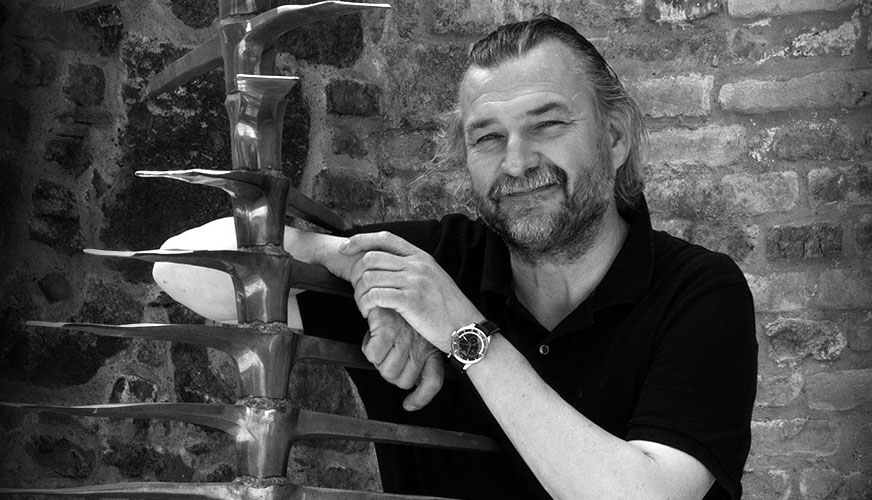
Sculptor, medallist, painter and university lecturer – head of the Department of Fine Arts and Multimedia at FAD STU (Faculty of Architecture and Design, Slovak University of Technology in Bratislava).
From 1981 to 1987, he studied at the Academy of Fine Arts (VŠVÚ) in Bratislava, in the sculpture department under Prof. Ján Kulich and Prof. Ladislav Snopko, and from 1985 to 1986 at the École Nationale Superieure des Beaux Arts in Paris under Prof. Jean Cardot.
In 1985, he received the Young Sculptor Award and in 1990 the Paul Louis Weiler Award, both awarded by the Académie des Beaux-Arts and the Institut de France in Paris. In 1988, he received the Martin Benka Award and in 1998 the “Prix Itinéraire” in Levallois near Paris.
In 1998 he was habilitated as an associate professor at the Academy of Fine Arts in the field of sculpture. Since 1990, he has been working as an associate professor at the Faculty of Architecture of the Slovak University of Technology in Bratislava (2006–2010 as head of the Department of Design, since 2011 as head of the Department of Fine Arts and Multimedia). He lives in Bratislava and devotes himself to monumental and chamber sculpture, relief, medals, drawing, and painting. He has had numerous exhibitions at home and abroad, as well as international presentations at world congresses and exhibitions of artistic medals organized by FIDEM (International Federation of Artistic Medalists). Laureate of the Crystal Wing Award for 2022 in the category of fine arts.
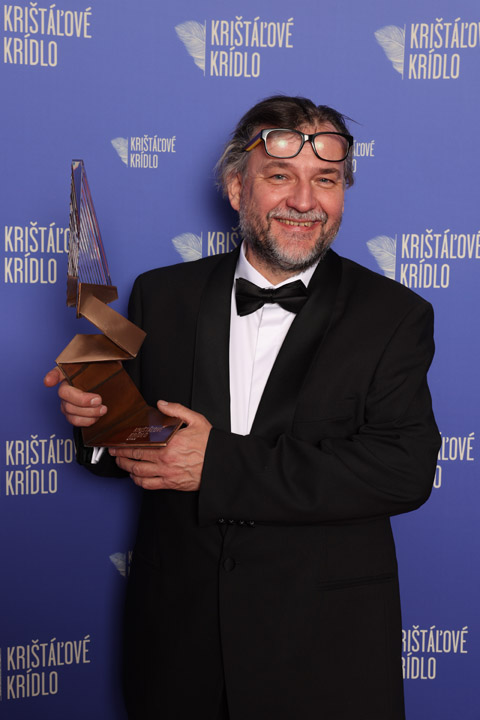
Doc. Milan Lehký – founder of Pharmacy Days
(academic sculptor Marián Polonský)


Mgr. Milan Lehký – publishing house Herba, Slovak Pharmaceutical Society
Struck by: Gravarte, Lisabon, Portugal
struck, two-sided, 90 mm, brass CuZn40Pb2
50 pcs
doc. RNDr. PhMr. Milan Lehký, CSc. – founder of Pharmacy Days (now the Milan Lehký Pharmacy Days of the Slovak Pharmaceutical Society)
Pharmacia medicinae soror, non ancilla (Pharmacy is the sister of medicine, not its servant)
The medal, which matured in the studio of one of Slovakia’s most prominent medalists, Marián Polonský (1943) for a full 5 years, which is undoubtedly reflected in its perfection and is further underscored by its impressive relief measuring on a respectable 90 mm; it fits perfectly in the hand and was struck at the Lisbon mint Gravarte.


doc. RNDr. PhMr. Milan Lehký, CSc.
(*July 21, 1925, Veľké Kozmálovce, Levice District, Czechoslovakia – April 25, 2018, Bratislava, Slovakia)

Milan Lehký – His Life and Work (HERBA Medical Literature Publishing House, Ltd., Bratislava, 2013, 112 pages, free PDF, in Slovak)
Life Milestones (click to expand)
1949-1953 študoval odbor farmácie na Lekárskej fakulte univerzity Komenského v Bratislave (PhMr. – pharmacia magister)
1953-1956 vedúci klinického oddelenia Slovakofarmy, n.p. Hlohovec
1956-1958 odborný pracovník Laboratória pre kontrolu liečiv, Medika Bratislava
1958-1969 pedagóg Katedry farmácie Slovenského ústavu pre doškoľovanie lekárov a farmaceutov Bratislava
1969 založil a stal sa vedúcim Katedry lekárenstva Inštitútu pre lekárov a farmaceutov, Bratislava
1970 doktor prírodovedy (RNDr. – rerum naturalium doctor)
1970-1978 vedúci Katedry farmaceutických laborantov
1970-1991 predseda Sekcie lekárenstva Slovenskej farmaceutickej spoločnosti, Bratislava
1972 založil tradíciu Lekárnických dní Slovenskej farmaceutickej spoločnosti
1975 habilitácia na docenta galenickej farmácie Farmaceutickej fakulty Univerzity Komenského v Bratislave
1980-1991 hlavný odborník pre lekárenstvo Ministerstva zdravotníctva Slovenskej republiky
1991 odchod do dôchodku
1992 založil vydavateľstvo Herba, spol. s r.o., Bratislava
1992-2007 konateľ a riaditeľ vydavateľstva Herba
1974-1990 koncipoval a prednášal predmet Klinická farmácia na Farmaceutickej fakulte Univerzity Komenského v Bratislave
1997-2004 editor a vydavateľ Slovenského liekopisu a Slovenského farmaceutického kódexu
Professional Resume (click to expand)
Autor alebo spoluautor 65 pôvodných vedeckých experimentálnych prác a knižných publikácií: Nežiaduce účinky liečiv, Materia Pharmaceutica
Odborník v oblasti analýzy a hodnotenia liekov, biologickej dostupnosti liečiv, problematiky riadenia lekárenstva a sociálnej farmácie
-> Popredný predstaviteľ slovenského lekárenstva, prvý vedúci Katedry lekárenstva Fakulty zdravotníckych špecializačných štúdií SZU.
Profesionálnu dráhu začal po ukončení štúdia farmácie v roku 1953 v národnom podniku Slovakofarma ako vedúci klinického oddelenia. V rokoch 1956 – 1958 pracoval v Laboratóriu pre kontrolu liečiv podniku Medika a v oddelení prípravy sterilných liekov nemocničnej lekárne Štátnej nemocnice v Bratislave.
Na základe súbehového konania sa v roku 1958 stal doc. Lehký odborným asistentom Katedry farmácie Slovenského ústavu pre doškoľovanie lekárov a od roku 1969 bol vedúcim novozriadenej Katedry lekárenstva vtedajšieho Inštitútu pre ďalšie vzdelávanie lekárov a farmaceutov. Vypracoval organizačnú štruktúru a plán rozvoja katedry. So svojimi spolupracovníkmi vypracoval špecializačné náplne základného špecializačného odboru lekárenstvo II. stupňa a nadstavbových špecializačných odborov, ako aj návrh pracovísk týchto špecializačných odborov.
Kvalifikačné atestácie vyššieho stupňa, určené predovšetkým pre vedúcich lekárnikov, začal realizovať v roku 1971, nasledovali nadstavbové atestácie v odbore organizácia a riadenie farmácie (1973), v odbore farmakodynamika, neskôr v odbore farmakológia a toxikológia liečiv (1975), v odbore veterinárna farmácia (1983), galenická farmácia (1984), v odbore klinická farmácia (1985) a liečivé rastliny (1986) Tieto boli určené pre vedúcich oddelení lekární.
Vznikom katedry sa položili základy inštitucionálneho ďalšieho vzdelávania farmaceutov v špecializačnom odbore lekárenstvo a v jeho nadstavbových špecializačných odborov. Tým sa zvýšil odborný potenciál poskytovanej lekárenskej starostlivosti.
Vznikom katedry sa doc. Lehký súčasne stal vedúcim jej výučbovej základne, lekárne NsP akad. L. Dérera. V rokoch 1970 – 1978 bol externým vedúcim Katedry farmaceutických laborantov Ústavu pre ďalšie vzdelávanie stredných zdravotníckych pracovníkov. V roku 1982 riaditeľstvo Inštitútu kladne zhodnotilo činnosť farmaceutických katedier a rozhodlo vytvoriť samostatný úsek farmaceutických odborov, ktorého vedúcim sa stal doc. Lehký, čo mu umožnilo koordinovať činnosť farmaceutických katedier.
V polovici 70. rokov minulého storočia v pregraduálnom štúdiu farmaceutov a v ďalšom vzdelávaní lekárnikov presadzoval novú orientáciu lekárenstva – klinickú farmáciu, ktorá sa stala špecializačným odborov farmaceutov a vyučovacím predmetom, ktorý začal prednášať na Farmaceutickej fakulte UK. V súčasnosti možno v tomto študijnom odbore v rámci doktorandského štúdia získať akademický titul doktor filozofie (PhD).
V rámci odbornej a vedeckej činnosti bol riešiteľom rezortných a ústavných výskumných úloh. Dosiahnuté výsledky publikoval v odborných časopisoch a prezentoval na odborných podujatiach, je spoluautorom 5 knižných publikácií. Sledoval rozklad adrenalínu vo vodných roztokoch pomocou oscilometrie (1968), zaoberal sa štúdiom podmienok uchovávania liečiv v lekárňach (1970), sledovaním rýchlosti uvoľňovania liečiv z masťových základov v pokusoch in vitro a in vivo (1975). Spolupracoval s kolektívmi zaoberajúcimi sa klinickým skúšaním a s laboratóriami vedeckých pracovísk, na ktorých sa sledoval transport katiónov v biologických membránach (kolektív vedený prof. RNDr. Michalovom – 1975) a klinický výskum cyklofosfamidu (kolektív vedený prof. MUDr. Šašinkom DrSc., získal v roku 1975 Hálkovu cenu). Knižná publikácia Sociálne lekárstvo a organizácia zdravotníctva (autorský kolektív vedený doc. MUDr. Makovickým) získala v roku 1978 Raimanovu cenu. Absolvoval študijný pobyt organizovaný Svetovou zdravotníckou organizáciou vo vybraných lekárňach vo Švajčiarsku, kde sa zaujímal o ich organizáciu a o prípravu injekčného roztoku rastového hormónu.
Docent Lehký zastával rad významných funkcií. Bol hlavným odborníkom ministerstva zdravotníctva pre odbor lekárenstvo, členom liekopisnej komisie, Vedeckej rady ministerstva zdravotníctva, členom vedeckých rád vtedajšieho Inštitútu pre ďalšie vzdelávanie lekárov a farmaceutov a Farmaceutickej fakulty UK, členom odborovej rady pre študijný odbor všeobecná farmácia ministerstva školstva, členom sekcie pre vedeckú a odbornú literatúru Slovenského literárneho fondu, členom zboru pre pestovanie a zber liečivých rastlín pri ministerstve zdravotníctva, členom vedeckého poradného zboru Štátneho ústavu pre kontrolu liečiv a členom redakčnej rady časopisu Farmaceutický obzor.
Zásluhou doc. Lehkého vznikla v roku 1970, v rámci Slovenskej farmaceutickej spoločnosti, Lekárnická sekcia, ktorej predsedom bol vyše 20 rokov. Počas 35-ročnej existencie Lekárnická sekcia organizovala v poradí už XXXIII. lekárnické dni.
V roku 1959 inicioval založenie farmaceutickej knižnej edície, neskôr nazvanej po A. Raimanovi, v ktorej vychádzali súborné knižné publikácie Materia pharmaceutica.

After retiring (October 1, 1990), he founded Herba spol. s r.o., a publishing house specializing in medical literature, in 1992. The company publishes the Small Medical Library, the Large Medical Library—the Dieška Edition—and the Pharmaceutical Library. To date, 50 books have been published. The publishing house was commissioned by the Ministry of Health of the Slovak Republic to publish the Slovak Pharmacopoeia (the Pharmacopoeia contains technical requirements for the preparation, manufacture, testing, labeling, and storage of drugs, excipients, and dosage forms) and the Slovak Pharmaceutical Codex, and has taken over the publication of the journals Medical Horizons (Lekársky obzor), Pharmaceutical Horizons (Farmaceutický obzor) a Our Medicinal Plants (Naše liečivé rastliny).

In 1998, Herba spol. s r. o. was awarded the SLOVAK GOLD medal for the publication of PROGLAS.

The book Proglas by Constantine the Philosopher (Proglas as a Preface to the Holy Gospel) is the oldest Slavic written monument.
It was first published in book form by Herba, spol. s r.o. in 1996. You can read the book for free on this website (Slovak).
Associate Professor Lehký has received several awards for his work: the J. B. Guot Medal, the Commemorative Plaque for Merits in Postgraduate Education of Physicians and Pharmacists, the Weber Medal (an award from the Slovak Pharmaceutical Society for pedagogical, educational, and scientific-research work), the Commemorative Medal marking the 50th anniversary of the founding of the Faculty of Pharmacy at Comenius University, and the PhMr. V. J. Žuffa Medal. He was an honorary member of the Czechoslovak Pharmaceutical Society and an honorary member of the Slovak Pharmaceutical Society.
In the context of institutional education for healthcare professionals in Slovakia, he made significant contributions to the continuing education of pharmacists and pharmacy technicians in the field of pharmacy, to the development of its subspecialties, and for his work on behalf of the pharmacy profession.
Text and photo: Mgr. Milan Lehký – Herba Publishing House, State Institute for Drug Control – Dictionary of Pharmaceutical Terms
Svätopluk (Ruler of Great Moravia)
(Drahomír Zobek)


Numizmatika Kremnica s.r.o.
struck, two-sided, 60 mm
Ag 999/1000, 2 oz (62 g)
150 pcs


A silver medal depicting Svätopluk I, Duke of Nitra and later ruler of Great Moravia
The portrait of Svätopluk is inspired by a costume design for the opera Svätopluk by costume designer and National Artist Elena Holéczyová (née Hollá) (* January 23, 1906, Moravské Lieskové – † December 5, 1983, Prague) – textile artist, playwright, and screenwriter.


Costume design for the character of Svätopluk in the opera of the same name by Eugen Suchoň
(Source: private archive of the Suchoň family, www.operaslovakia.sk)
“For me, Svätopluk is first and foremost a conqueror, and only thirdly a God-fearing Christian,” says Drahomír Zobek, the medal’s designer, owner of Numizmatika Kremnica s.r.o., and a medalist from Kremnica. On the medal’s chest, Svätopluk wears a clasp featuring a griffin, which represents a historical anachronism. The crown adorned with hanging plates is quite plausible.
The reverse side, depicting Svätopluk on a rearing horse with the inscription “Moravia Magna” (Great Moravia), is purely the artist’s interpretation.
https://numizmat.sk/en/silver-medals/svaetopluk-i-ruler-of-great-moravia-silver-medal
Drahomír Zobek (*20.7.1952 Nová Baňa, Czechoslovakia) – important Slovak medallist. He is the author of art designs of Slovak circulation coins (1993), replicas of coins and a number of medals (minted and cast), decorations, badges, etc.
1967-71 – Secondary School of Arts and Crafts in Kremnica, graphic, surface and plastic engraving. After graduation (29.7.1971) he joined the studio of the Kremnica mint, where he worked as the head of the studio in 1992-1997. In 1997 he became independent.
http://coins.lmsystem.sk/index.php?p=Tema/Autor/ZobekDrahomir
In 2022, his Pribina Medal won the Medal of the Year 2022 award (in Slovak / please use some machine translation tool)
Zeus and Hercules, Greek Myths and Legends
(Drahomír Zobek)


Numizmatika Kremnica s.r.o.
struck, two-sided, 32 mm
Ag 999/1000, ~16 g
200 pcs
A silver medal in the shape and with the specifications of a tetradrachm, depicting the warrior Hercules and Zeus, the supreme god of ancient Greece, as a scene from Greek myths and legends
Obverse: Zeus, Greek inscription Διός (Dios)
This portrait of Zeus is a reproduction of the most famous ancient portrait of Zeus—a bust carved from Carrara marble found in 1775 in Otricoli (Umbria, Italy), which is considered a copy of a lost ancient Greek bronze bust/statue from the late 4th century. The bust is larger than life, standing 58 cm tall, and can be found in the Vatican Museums (Museo Pio-Clementino, Sala Rotonda – the Round Hall).

This ancient model also inspired other medalists in the past


Olympic winner’s medal from the 1st modern Olympic Games in Athens, 1896
silver, 5 × 0.45 cm, 66 g, minted by the Monnaie de Paris, designed by Jules Clément Chaplain (July 12, 1839–July 13, 1909) – a French sculptor and one of the most significant French medalists of the 19th and early 20th centuries (to which the roots of Czech and Slovak medal-making tradition also extend—more in a forthcoming article on the origins of our medal-making tradition)
Reverse: Hercules wrestling with a lion, Greek epigraph – original design
https://numizmat.sk/en/planned-mintages/tetradrachma-hercules-greek-mythology
Terra
(academic painter Daniel Brunovský)
independent artwork
cast, one-sided
Bronze, ~90 mm – 20 pcs max.
Silver Ag, ~60 mm – 20 pcs max.
III. medal from the cycle Elements (Aqua, Ignis, Terra, …)
The medal was exhibited at the XXXVIII FIDEM Munich 2025 World Exhibition of Modern Art Medals
Medal Aqua attented Medal of the Year 2023
– cast bronze ~90-93 mm, cast silver ~60 mm – limit max. 20 pcs, numbered

Medal Ignis attented Medal of the Year 2024
– cast bronze ~90-93 mm, cast silver ~60 mm – limit max. 20 pcs, numbered

-> video of the medal Ignis on Instagram
Brunovsky’s unique style can be described as Baroque Surrealism.
Brunovský is an universal artist – painter, jeweller, also devoted to sculpture, son of the famous Slovak painter Albín Brunovský, representative of the imaginative line (another representative Vladimír Gažovič, their admirer and in some works inspired by Marián Polonský). Daniel Brunovský, however, found his own way and style.
He is the author of several unique medals.


Daniel Brunovský (1959, Bratislava, Slovakia, Europe), member of the SAMS – Slovak Art Medal Society (ZMS – Združenie medailérov Slovenska)
1974-1978 School of applied art in Bratislava, 1979-1985 Academy of Fine Arts and Design in Bratislava. In 1984 he also studied in Rome at the Academia di belle Arte. He is currently working on graphic art, ceramic and glass sculpture, furniture solitaires, jewellery and medals. Daniel Brunovský is a representative of Slovak postmodernism and has been making art for more than twenty years. Already at the beginning of his creative journey he expressed himself in his own artistic language and to this day he has remained faithful to the classical medium of painting, in which he seeks inner freedom and harmony. In his large-scale figurative compositions, he gives a testimony of man’s connection with ancient landscapes, architecture and history. With his unique style, the painter creates stories about people, about their innermost feelings and searches for the most elemental human needs, desires and dreams that are often lost in modern civilization. He records all these elements in a dynamic and expressive handwriting, often inserting texts in the form of puzzles and a number of symbols into his works to amplify the effect of his authorial statement. In paintings dominated by robust figures, he presents the relationship between man and the cosmos, confronting the material and spiritual worlds. The basic motif here is the complexity of interpersonal relationships and the psychological loneliness of a man lost in space. In Daniel Brunovský’s paintings there is always something deliberately left unsaid, mysterious, almost mystical.

Fhoto: Peter Kočvara, https://www.webumenia.sk/autor/1350
text: https://www.osobnosti.sk/osobnost/daniel-brunovsky-1761
https://www.magnagallery.sk/daniel-brunovsky-modry-pribeh/

Statute of the Medal of the Year Award
1. Definition of the award/label:
– Medal of the Year
2. Organizer:
– Medailérsky klub, non-profit organisation
3. Medal Nomination Conditions:
– medal has been issued/created in the given year
– by a Slovak author or made in Slovakia or with a Slovak theme,
– multiple identical pieces were created (by striking/minting, casting, …)
Definition of a medal for the purposes of the poll/competition:
– dimensions min. 37 mm and max. 200 mm in one dimension,
– it is not a coin (legal tender with currency and denomination),
– a table medal (not hanging on a ribbon)
– original works—not created with the help of artificial intelligence or by computer using photographic templates or computer fonts
4. Medal of the Year Committee
4.1 The Medal of the Year Committee (hereinafter referred to as ‘the Committee’) is a body composed of experts and professionals
4.2 The purpose of the Commission is to act as an expert advisory body, e.g. in the selection of the nominations submitted and in the actual voting for the Medal of the Year.
5. Process:
– 1. nomination submissions, 2. selection of nominations for voting, 3. voting/poll, 4. evaluation of winner(s)
5.1 Proposals for nominations
Anyone can submit their nomination proposals. The nomination must include the required details with at least the following information necessary for proper identification of the medal, together with an accompanying photograph of the obverse and reverse, if applicable:
– name of the medal, name of author(s), manufacturer, customer, material(s) (all known variants – designs and finishes, such as patinated tombac, silver-plated tombac, bronze, silver, copper, …), mintage (number of pieces), dimensions (in mm), method of production (striking/minting, casting, …), as well as additional information such as a description of the medal or other interesting information.
Proposals can be sent in the manner specified by the organiser (online form, e-mail). The organizer reserves the right to request additional data or better photographs, as well as at its discretion not to consider all nominations, especially if they do not contain the required elements, even without giving a reason.
5.2 Selection of nominations for voting
From all the nominations submitted, the organiser or the committee shall select, at its discretion, the entries for voting. According to the nominations sent in, the organiser/commission reserves the right to create individual categories of medals (according to size, production technique, etc.).
5.3 Voting
Voting consists of a public vote/poll and, eventually, a vote of the committee. Anyone can vote in the public vote/poll and only once, repeated responses will not be taken into account; the last response will be considered a valid vote.
Voting takes place remotely by means of an online form or ballot papers and it is necessary to fill in the e-mail address and the required information.
5.4 Evaluation of the winner(s)
The winner(s) in each category, if applicable, will be selected based on the number of votes cast by the public (and, eventually, the committee, either according to a specified proportional key or separately).
6. Other
6.1 Prizes
The competition may award prizes of value to the voting participants; these prizes are not claimable, the organiser will select the winners at its discretion in an anonymous manner (by draw/computer) and the organiser will not consider any objections. Prizes of a value not exceeding EUR 350 per prize or prize are exempt from the Income Tax Act.
7. Final provisions
By participating in this survey, each participant agrees to the terms and conditions set forth herein or elsewhere in the survey.
The Organiser reserves the right to determine all conditions and procedures (e.g., in selecting nominations for medals, candidates for the committee, voting, the method of selecting and announcing winners, drawing prize winners, etc.) or assessing compliance with the conditions set out in these rules, and at the same time is not obliged to take into account any objections or comments at its discretion.
THANK YOU!


